

The most important news from Davos
Key Markets report for Tuesday, 27 January 2026

Over the past week, analysts and commentators discussed many details of the recent WEF summit in Davos. However, what should have been the Forum’s greatest revelation attracted little attention. Namely, at Davos, Donald Trump and his delegation made it clear that the United States is definitely turning a page: not so much over Venezuela, Greenland or any other geopolitical consideration. The U.S. is changing its system of governance.
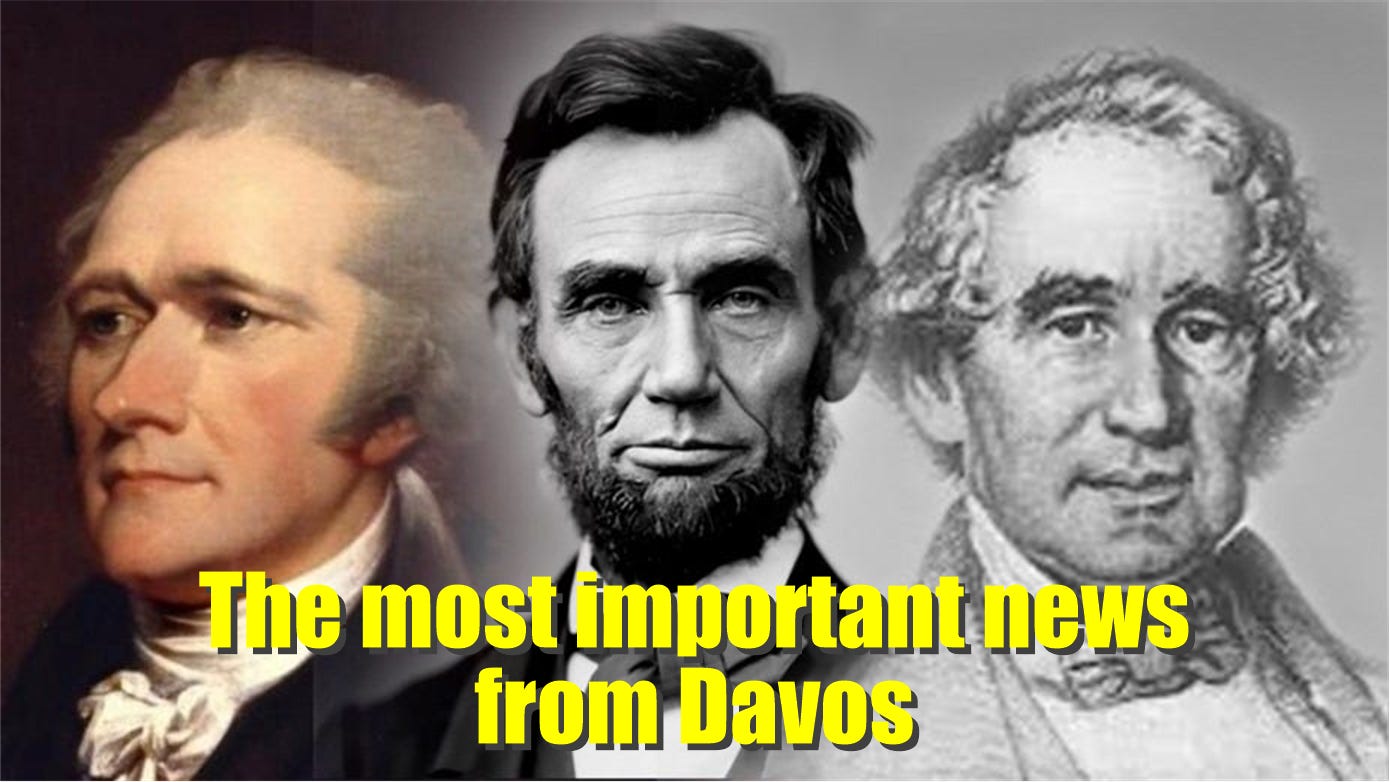
Changing U.S. system of governance
Given that the effects of this change will be massive, far-reaching and long-lasting, it is strange that this is being glossed over. Some of the media acknowledged it, but they do so as though it’s a cosmetic change, without elaborating what it entails. It would be hard to overestimate the implications of the Trump Administration’s strategy. On 23 April last year in this report, I published an article titled, “Trump vs. the bankers: is the struggle for real?” At the time, I anticipated this change:
I suspect that Trump’s ultimate agenda could be aimed at returning the United States to Alexander Hamilton’s American System of political economy and away from the British free trade system. The difference is that the American System allocates credit for industrialization and productive ends while the British free trade system credits nonproductive uses aimed at inflating, then bursting asset bubbles.
The contrast between the two systems was described by Abraham Lincoln‘s chief economic advisor Henry C. Carey in his 1851 work, “The Harmony of Interests.” Carey’s prose could be summarized as follows:
Trade vs. production: one system directs capital and draws labor (the productive potential of a people) toward trade and speculation, which depress wages and erode prosperity. The other system fosters production of goods, services and infrastructure. It leads to higher wages and rising standards of living.
Raw materials vs. finished goods: one system favors mass production of raw materials and cash crops for trade; it systematically impoverishes farmers and reduces their employment. Carey writes about farmers bearing most of the burden of freight in wholesale trade. The other system favors production of more refined, finished output, providing quality products to the market while enhancing the prosperity of the producers.
Exporting produce vs. enjoying it at home: one system sends mass produced bulk abroad, frequently causing famines, while the other absorbs labor to produce diverse, quality products at home.
Concentration vs. dispersion of wealth: one system concentrates wealth and power in great commercial cities while depleting and impoverishing the rest of the nation; the other enriches those engaged in production and disperses wealth more broadly.
War vs. moral and intellectual growth: one system compels the productive sector to fund fleets and armies; the other directs the same means for moral and intellectual growth of the people in their own nations.
Stable communities vs. population replacement: one system requires a large, low-skilled labor force that accepts work with low wages. It predictably resorts to mass influx of migrants. The other system raises the standards of living, prosperity and security of native labor force.
Universal war vs. universal peace: one system gives rise to universal forever wars; the other preserves peace.
As we explored in previous TrendCompass reports, wherever the American System was applied properly, it did in fact, generate prosperity and abundance: in the U.S., Germany, Russia, China, Japan, etc.
There’ll be a reaction
But in adopting the American System, Trump will alienate all those economic “elites” that have benefited abundantly from the “free trade” system and who are today among the world’s most powerful groups. For this reason, Trump’s turn was never made in clear and equivocal term - it came across more like populist campaign slogans. From last April’s TrendCompass:
It is possible that in his effort to “Make America Great Again,” Trump wants to return it to that system. However, he obviously can’t come out and state this openly: all eight U.S. presidents who have either been assassinated or “mysteriously died” in office were promoters of Hamilton’s American System. Those presidents were William Henry Harrison (9th, 1941), Zachary Taylor (12th, 1850), Abraham Lincoln (16th, 1865), James Garfield (20th, 1881), William McKinley (25th, 1901), Warren G. Harding (29th, 1923), Franklin D. Roosevelt (32nd, 1945), and John F. Kennedy (35th, 1963).
This all changed last week in Davos, and the Administration’s intentions were made in terms that could not have been clearer. It’s true that Trump didn’t elaborate on the American System at the World Economic Forum, but delivering that message was clearly his delegation’s mission, especially by the Secretary of Commerce Howard Lutnick, Treasury Secretary Scott Bessent, and the Trade Representative Jameison Greer.
Globalization failed
Lutnick was blunt, stating categorically that “globalization failed,” and that the Trump Administration’s approach adopted, “a different way of thinking, it’s completely different than the WEF.” Secretary Bessent echoed the message about the “different mindset,” but invited world leaders to, “come and join us. Grow with us, prosper with us…” Trade representative Jamieson Greer offered the most unequivocal message to Davos in his 20 January speech titled, “From Hamilton to Today: Trade and U.S. Economic Strategy.”
Greer’s remarks made the message unequivocal. He explicitly mentioned Alexander Hamilton, Abraham Lincoln, Henry Carrey and others who struggled for, and championed the American System over the centuries as well as the spectacular results the system achieved for the United States. For example, under Henry Carey’s guidance,
“America raised its tariffs on the world, and economic development surged… By 1913, U.S. per capita industrial output was the greatest in the world, 10 percent greater than that of the United Kingdom, and 600 percent larger than it was in 1860. According to one study, total American industrial production soared by 1,030 percent from 1860 to 1910.”
To boot, Greer correctly characterized the British Empire’s system of free trade (or “open society,” as Soros calls it) as a “downwards race to the bottom.” The positive aspect to all this was that Trump and his delegation came to Davos not to confront and antagonize the WEF attendees, but to encourage them to adopt the American System and change tack from being “prophets of doom and apocalypse” (as Trump called them in his 2020 speech) to embracing the idea of building prosperity and abundance for all. My own impression was that Trump will have changed many hearts and minds in Davos.
Will the rupture involve a Civil War?
It is entirely possible that such a transition could involve a Civil War breaking out in the United States, as it did 163 years ago. Under the American System, the United States became an industrial power and a rival to the British Empire. But its Southern states remained the Empire’s commodity exporter, heavily dependent on slave labor. Its elites resisted the lead to industrialize and abolish slavery and in this it obtained full backing and support from European colonial powers, primarily Britain and France.
In fact, some observers believe that flooding the United States with uncontrolled immigration and illegal narcotics was being done deliberately and systematically in order to weaken the nation and destroy it if ever it tried to abandon the free trade system and revert to Hamiltonian principles. Today’s events in Minnesota could be an escalation in that direction, but it’s unlikely that the Administration will back down.
To learn more about TrendCompass reports please check our main TrendCompass web page. We encourage you to also have a read through our TrendCompass User Manual page. For U.S. investors: an investable, fully managed portfolio based on I-System TrendFollowing is available from our partner advisory (more about it here).

Today’s trading signals
With yesterday’s closing prices we have the following changes for the Key Markets portfolio:
