

Iran deprives Trump of a victorious exit
Key Markets report for Tuesday, 7 April 2026

The long Easter weekend was more eventful than usual, including a Hollywood-like saga about a heroic rescue of a downed U.S. pilot (or two pilots) on Saturday, 4 May 2026. Here’s what we know from reliable sources and officials with insider knowledge of the situation and who spoke on condition of anonymity: on Friday, 3 May, (or Tursday, 2 May according to some reports), Iranian air defense forces shot down a U.S. F-15 jet in Iranian air space in the Khuzestan province near the Persian Gulf coast.
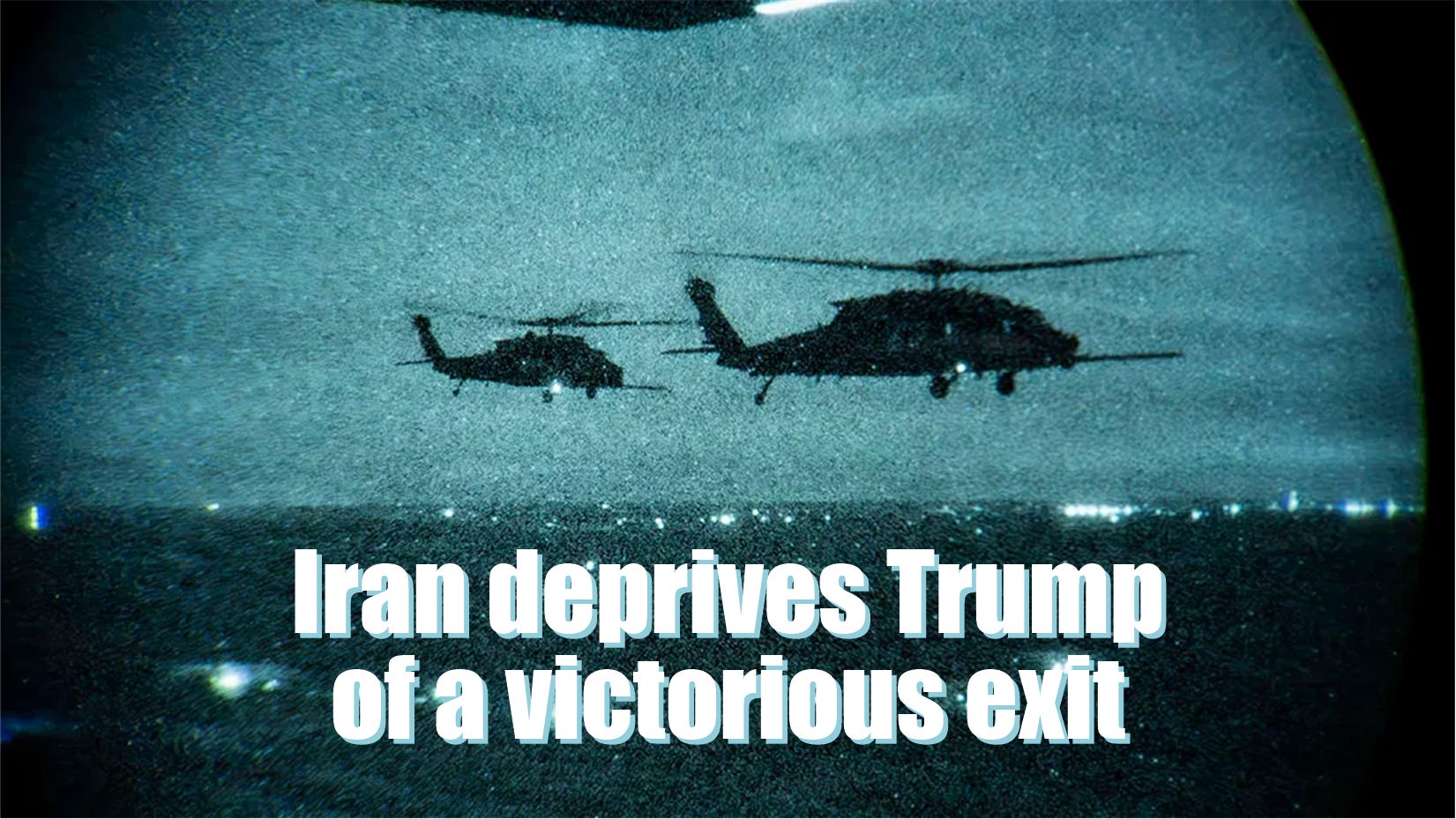
The two crew members—the pilot and weapons systems officer (WSO)—ejected separately and Search and rescue (SAR) mission was launched to recover the officers. The pilot was rescued relatively quickly, but the second, WSO officer managed to walk 110 miles (about 180 kilometers) northwards, in direction of Isfahan, even though he was injured. He then scaled rugged mountain terrain to hide until his own rescue mission arrived.
The WSO’s rescue apparently necessitated a major, high-risk ground operation which involved anything between “dozens to over 150 aircraft,” including, according to Reuters, “Two MC-130 aircraft that had ferried some of the roughly 100 special operations forces into rugged terrain south of Tehran.” However, these two aircraft both suffered a mechanical failure and could not take off, so they had to be destroyed and an additional SAR mission had to be launched to recover the first SAR mission and the wayward WSO.
We got him!
Other than losing at least six aircraft (12 according to Iranian sources), the mission was completed successfully and President Trump triumphantly posted the following on TruthSocial:
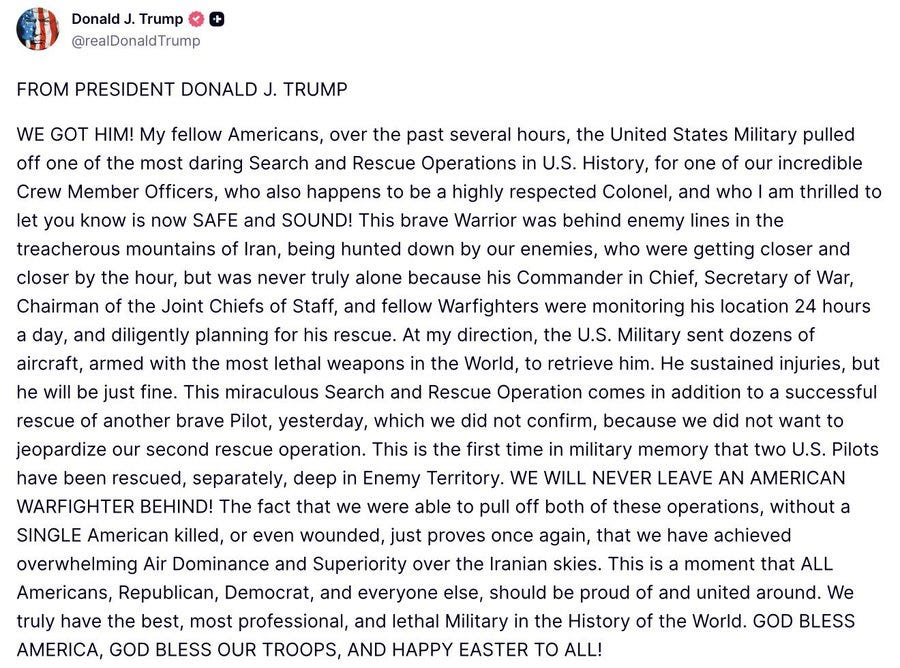
Trump posted that in the morning (11:08 AM EST) of Saturday, 4 April 2026, but the whole affair simply didn’t add up and gave rise to very lively discussion in social media. Why did the government not disclose the Pilot’s identity? Why did they not show him returning home? Why were “dozens” of aircraft and 100 troops involved in a mission that should, if anything, have been a stealth one?
Trump’s attempt to exit the war victorious?
After a busy weekend of speculation and analysis by former military officers familiar with similar operations, it would appear that the real mission into Iran was a secret, covert operation that derailed. Its most likely objective was the capture of some 440 kilograms of 60% enriched Uranium hexafluoride, which U.S. intelligence believed to be hidden in underground nuclear facilities near Isfahan.
Marine veteran and former U.N. weapons inspector Scott Ritter believed as much because the rescue operation included at least 30 to 40 Delta Force troops. These troops don’t specialize in SAR missions. Instead, their specialty is forcible entry into secure facilities, like the underground bunkers where the Iranians are hiding their nuclear materials. It is quite plausible that Trump’s intent was to capture Iran’s stockpile of enriched Uranium, declare victory, and take advantage of this to declare the war over and withdraw.
Ritter thought that, “this mission is a sign of desperation.” Former National Security Advisor John Bolton thought the same: “Trump is in a panic and wants to find a way to emerge from this war by declaring victory, whether the Strait of Hormuz remains open or not.” The particularly embarrassing aspect of this is that the downed F-15 (the Iranians insist it wasn’t an F-15 but an F-35) was struck by Iran’s anti-aircraft missile, less than 24h after Trump declared that Iran’s air defences have been destroyed and that the U.S. has air supremacy over Iran.
Words matter
Then, before dawn on Sunday, 5 April 2026, Trump published a profanity-laced post that seemed to confirm Ritter’s and Bolton’s characterization of his predicament:
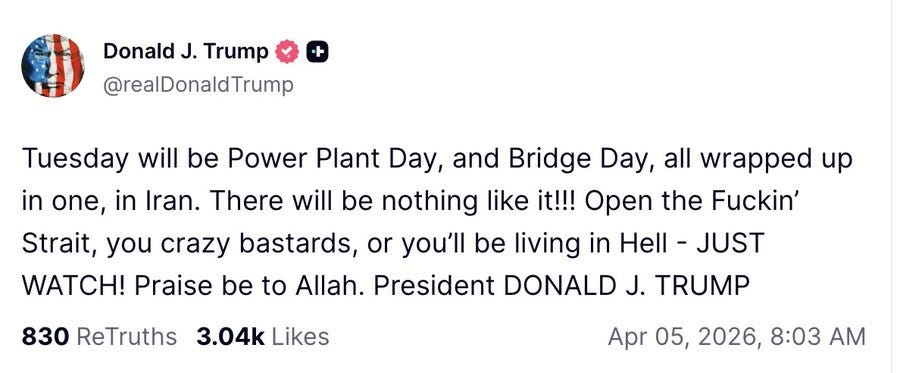
Trump’s wording does not suggest a Commander in Chief who is in control and speaks from a position of quiet confidence. Instead, Trump is projecting an impotent rage as he’s sinking deeper into a quagmire entirely of his own making while his adversaries, seem confident in their defiance.
But beyond all this, many Americans felt offended by Trump’s words. On Easter Monday, one of the biggest Christian holidays, Trump chose to not only post profanities, but inexplicably also ended his message with “Praise be to Allah.” For many Americans, this is a massive affront to their sensitivities which can’t be brushed aside as the President having a bad day at the office. When I was a teenager I was invited for dinner to the home of a devout California Christian family one evening. At one point the whole group fell silent and I got a strong reprimand because I used the word, “hell.” (I think I said something like, “what the hell…”).
Obliteration of Iran or a ceasefire?
In spite of Trump’s repeated threats to obliterate their country, the Iranians are refusing to back down, offering him no face-saving exit from the war he started. The new (old) deadline he gave them to open the “F#^kin’ Strait” is tomorrow evening, 8 April (at 8 PM EDT), failing which he threatened to destroy Iran’s electricity grid and its key bridges. And this time, it seems, he really, really means it.
At the same time, media have been abuzz about ongoing discussions about a proposed 45-day ceasefire tied to reopening the Strait of Hormuz. Apparently, mediators from Egypt, Pakistan, and Turkey have sent a draft proposal for a 45-day ceasefire and a reopening the Strait of Hormuz to the Iranians and the Trump administration. The U.S. and Iran both received the supposed draft, but while Trump described Iran’s response as “significant but not good enough,” the Iranians outright rejected the proposal.
They argued that a ceasefire would merely allow their adversaries to regroup and breach the terms whenever they thought it expedient. Instead, Iran continues to demand a lasting peace, sanctions relief and broader regional de-escalation of the conflict, the terms of which amount to a capitulation by their adversaries. For his part, Trump has publicly stated that talks are ongoing but he emphasized leverage through threats rather than announcing any truce.
Will Trump make Iran great again?
As a result, the hostilities are continuing and the situation remains extremely tense. One of the most obvious effects of all this is the continuing strength of the oil price which is refusing to correct. At the moment of this writing, Brent crude oil is trading just below $114/barrel, where it has been consolidating for the last four weeks. During that time, it seems that there’s less and less selling pressure with each successive pullback, while buying pressure seems to be building up, suggesting that we might see another strong rally this week, perhaps toward $120/bbl or higher.
In the end, Trump’s gambit in Iran could prove yet another spectacular episode of unintended consequences and opposite outcomes. It will make the oil price great again, and with it Iran which is now reported to be earning much more from its oil exports than it did before the war, not to mention their new toll transit system for Hormuz.
To learn more about TrendCompass reports please check our main TrendCompass web page. We encourage you to also have a read through our TrendCompass User Manual page. For U.S. investors: an investable, fully managed portfolio based on I-System TrendFollowing is available from our partner advisory (more about it here).

Today’s trading signals
With Thursday’s closing prices we have the following changes for the Key Markets portfolio:
