

AI: "minimally sufficient" (for the most part)
Key Markets report for Thursday, 30 April 2026

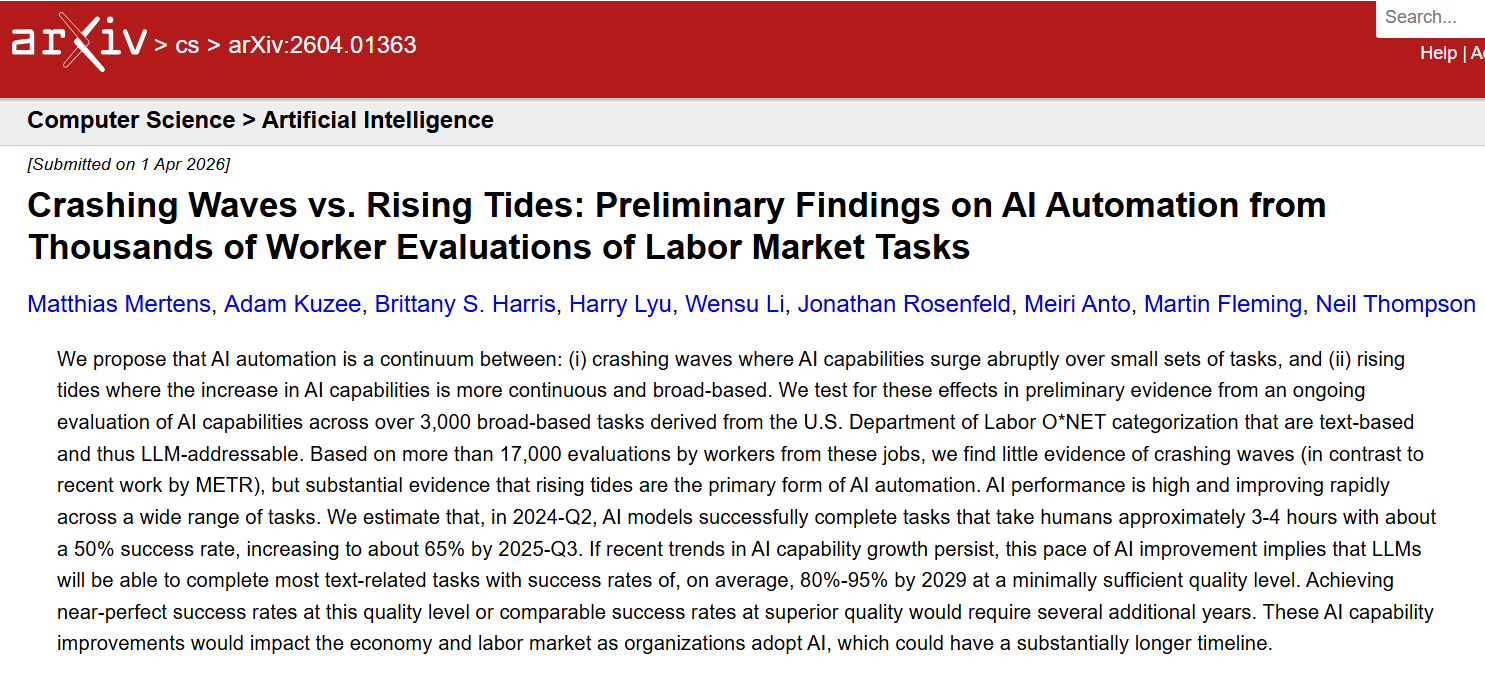
Earlier this month, I published two articles on limitations of AI here and this week we put together a video report based on both articles (see below). Just as we were finishing up, further corroboration that AI might not live up to the hype came to my attention. Namely, MIT Future Tech published a report titled, “Crashing Waves vs. Rising Tides: Preliminary Findings on AI Automation from Thousands of Worker Evaluations of Labor Market Tasks.”
The researchers tested 41 different large language models (including versions of Claude, Gemini, and ChatGPT) on more than 11,000 real workplace tasks drawn from the U.S. Department of Labor’s O*NET database, the standard reference for real job descriptions and tasks across professions.
Experienced human workers in those fields (thus, not generic evaluators) scored the outputs of AI models on a 1–9 scale where the score of 7 denoted “minimally sufficient” work. Top score, 9, denoted superior/excellent quality work.
Minimally sufficient
The results of the study weren’t great: AI got the “minimally sufficient” score on about 65% of the tasks. It struggled with higher-quality output: the chance of reaching superior quality (score 9) never exceeded 50%, even with more time or compute. Furthermore, performance varied by job type: AI is better on routine text-based tasks in fields like construction/maintenance but tends to fall short in skilled roles like legal and IT.
Overall, it seems that AI is “good enough to pass but not good enough to impress”—more like a disenchanted intern that can handle the bare minimum on many routine tasks but still needs significant human oversight for quality, creativity, complexity, or low-error domains.
The MIT report did find that AI is improving (allegedly up to 11% per year), with projections that by 2029 most models could reach the minimally sufficient level on 80-95% of tasks. This frames automation as a gradual “rising tide” rather than sudden “crashing waves” that would replace jobs overnight so, hopefully, over the long run the massive investment will churn out something better than “minimally sufficient” work.
In fact, “Crashing Waves vs. Rising Tides” largely confirmed the impression I reached discussing it with other authors and researchers: kinda OK but not really. The video summarizing these earlier materials is below and it features another AI fail; I’m almost never as grumpy as in this AI-generated thumbnail made me look:
To learn more about TrendCompass reports please check our main TrendCompass web page. We encourage you to also have a read through our TrendCompass User Manual page. For U.S. investors: an investable, fully managed portfolio based on I-System TrendFollowing is available from our partner advisory (more about it here).

Today’s trading signals
With yesterday’s closing prices we have the following changes for the Key Markets portfolio:
