

China vs. the West: which system is better?
Key Markets report for Thursday, 21 May 2026

This question is not so easy to answer, particularly given its ideological aspects: we all know that modern liberal democracies with free market capitalism gave rise to the most free and most prosperous societies in history. On the other hand, communism under an authoritarian rule is easily the worst kind of system, and that’s what China has under its odious CCP dictatorship. At least so far as labels and convictions go, most people in the West would agree: liberal democracy good, China bad.
However, those convictions are invariably rooted in ideology rather than a clear-eyed analysis of reality. An analysis of any system should focus strictly on what the system does: on outcomes it produces. The recent visits by President Trump and Russian Federation’s President Putin in China focused the world’s attention on China in a way that took notice of certain realities of her society that we normally overlook. The large American and Russian delegations and all the international journalists that followed their meetings in Beijing were clearly impressed with what they found there.
The wealth of nations
Among them were Nvidia’s CEO Jensen Huang and Elon Musk - two individuals who should be generally hard to impress. One reporter was Naval Ravikand, who spent ten days in China. He knew about China from reading and seeing content online, but was still taken aback what he experienced on visiting China. As an example, he mentioned the high-speed rail network which has by now grown to over 50,000 kilometers and is transporting millions of people daily at 300 km/h quietly, comfortably and on time.
But what impressed Ravikand was the very fact that such monumental pieces of infrastructure even exist: building such systems involves also monumental investments whose payoff is measured in decades, not years. And China’s renaissance doesn’t only involve physical infrastructure or manufacturing capacities - it involves equally extensive, long-term investments in education for young people and in institutions that provide that education. This suggests a very long-term view of China’s leadership.
Their 15 consecutive 5-year plans have raised China from being the world’s poorest country in the early 1970s to being an economic superpower that’s already transcended the position of being the world’s manufacturer of other people’s designs and technologies to being the world’s most vibrant generator of innovation, producing breakthrough in new technologies, materials and processes.
Our free market ideology looks at any government involvement involvement in the economy, let alone crafting 5-year plans, with suspicion. We know with certainty that governments everywhere bungle everything they touch, and that private enterprise invariably produce the best, perpetually self-perfecting outcomes. But China’s central planers and their 15 five-year plans have produced very impressive results nevertheless, and it’s not just in things they built - it’s also in the system that builds them. The list could be very long, but here are just a handful of examples:
This incredible video shows the transformation of land, from a desert to a vibrant city (Jiayuguan) in only 20 years. This is only one of many examples: in the same period, Shenzen was transformed from a fishing village into a leading global technology hub.
This video shows modern apartment blocks in Communist China (where 90% of people own their homes and pay zero property taxes).
An entire train station in Fuzhou City, in Fujian Province was built in just 9 hours.
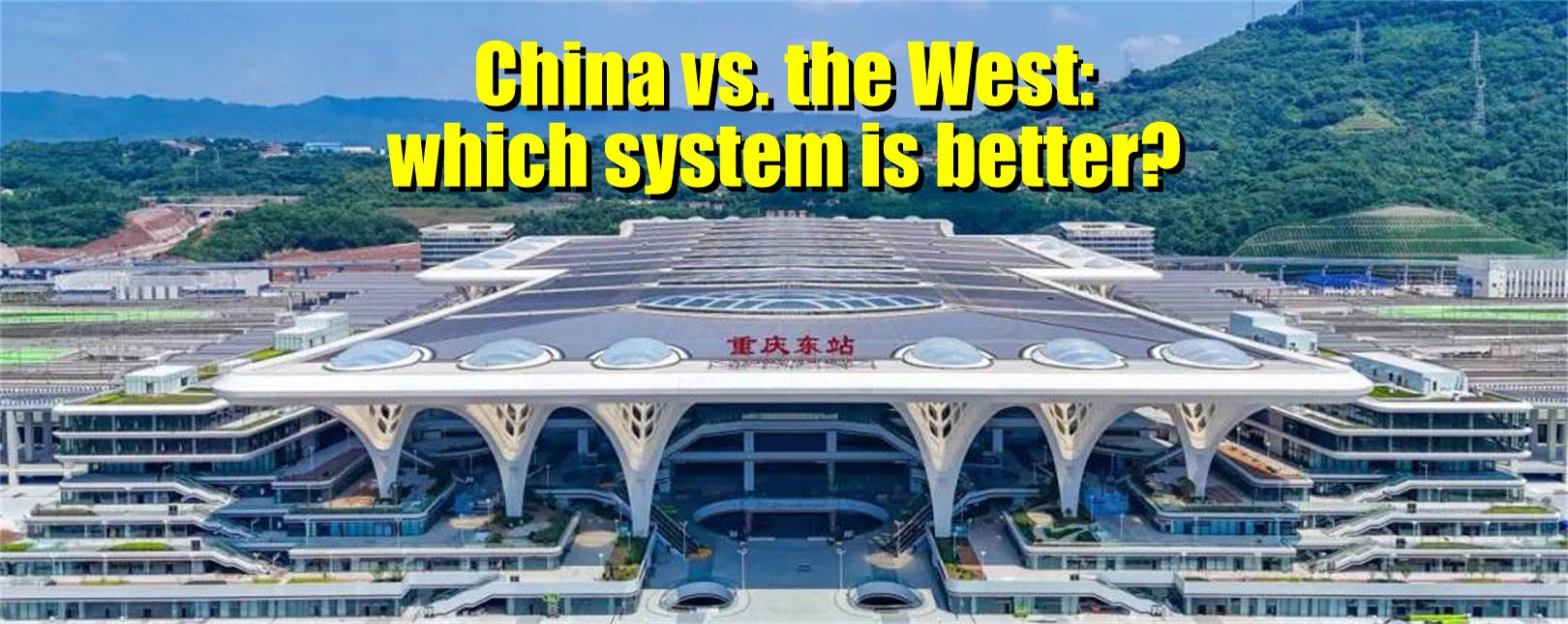
In Chongqing they built a massive high-speed railway hub covering 1.22 million square meters in a place that, only 38 months ago was a mountain. The whole structure is an impressive architectural masterpiece on the scale of Egyptian pyramids (here’s a 5-min. documentary about the station’s construction and a 2-min. drone fly-through). The construction cost $7.8 billion.
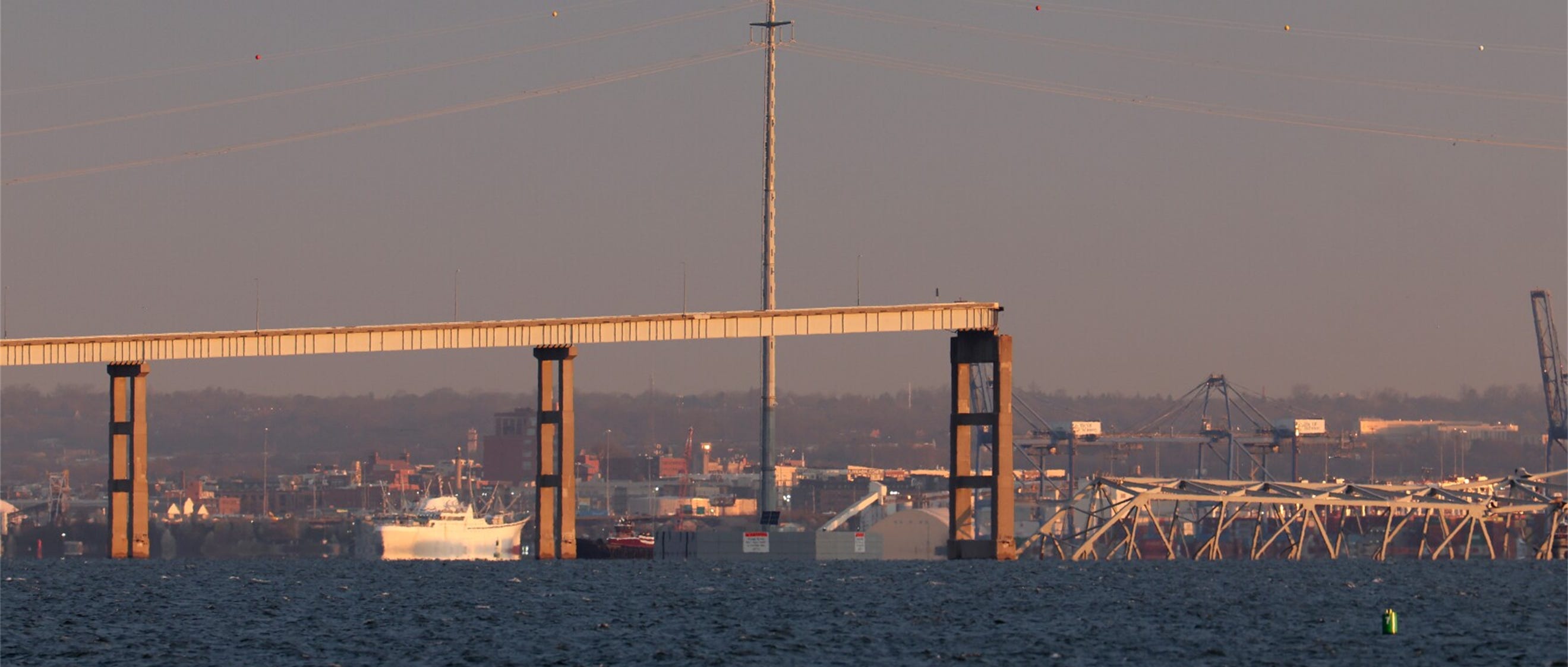
Compare these last two examples to the Francis Scott Key Bridge in Baltimore which collapsed in March of 2024 and which is expected to be reconstructed by late 2030 (more than six years from its collapse) at a cost currently estimated at $4.3 - $5.2 billion.
The horrid case of free market health-care
The issue of health care offers perhaps the sharpest contrasts between the two systems. As we saw in yesterday’s report, U.S. health care system represents about 18% of the nation’s GDP. That amounts to $5.3 trillion (up 7.2% from 2023), or $15,474 per man, woman and child living in the United States. All but about 60 nations in the world have total per capita GDP of $15,474 or higher, and China is not one of them. China’s per capita GDP is about $13,800 and her health-care spending is about 6%, or $828 per year.
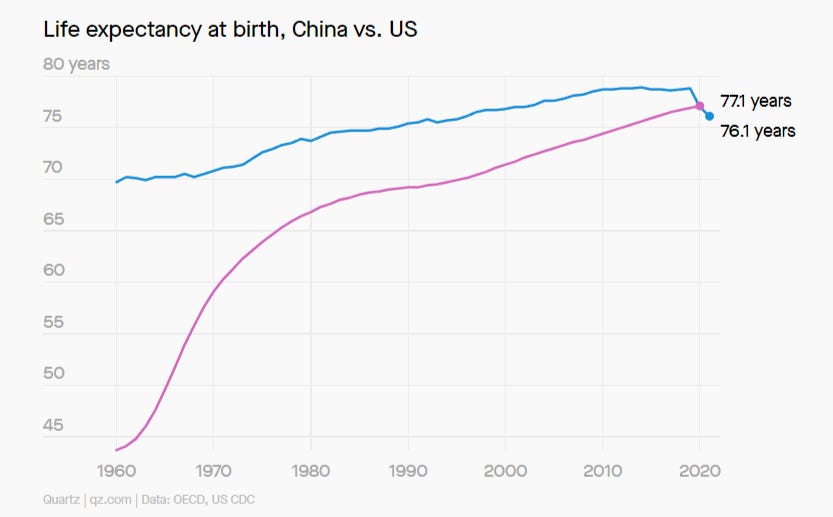
And what do American people get for spending more on health care than any other nation in the world, and nearly 20 x what the Chinese spend? That question is quite a big debate, but few would argue that they get a Rolls Royce quality of life or a supersized life expectancy. In fact, they get a shorter life expectancy than the Chinese people:
And they get substantially shorter life expectancy relative to other developed nations:
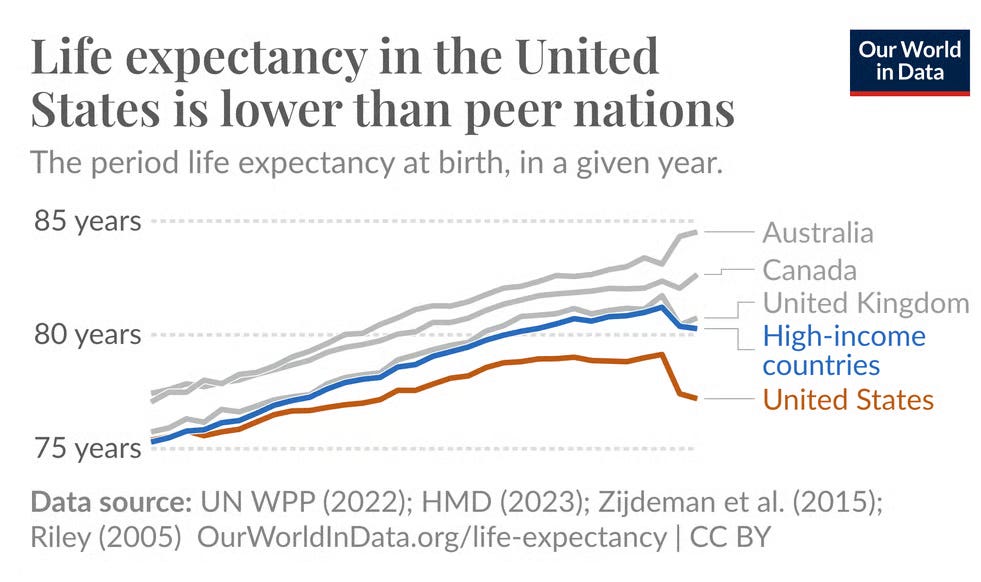
According to the Peterson-KFF Health System Tracker, the Americans’ life expectancy at birth is 4.1 years shorter than that of other developed nations.
Ideology vs. reality - compare and despair
Our ideology says that free market capitalism produces best outcomes - best quality goods and services and most competitive prices. The reality says something else altogether: the U.S.A., mothership of free market capitalism has the world’s most expensive health care system which provides some of the worst outcomes in the world.
I wouldn’t even know how to draw a comparison between the American and Chinese infrastructure as it involves quality, maintenance, how much it costs, how quickly it is built and how extensive it is. The Baltimore bridge is one example. The fact that the U.S. still has close to zero high-speed rail connections is another.
Clearly, not only are our ideological precepts mistaken, they could be a complete categorical mismatch: it is not at all about democracy vs. autocracy nor about capitalism vs. communism. The essence of the matter, most likely, is in the system of incentives that ultimately determine outcomes in a society. If those incentives deplete the economy in order to squander its wealth in foreign wars, that’s what we’ll get. If they encourage investment in betterment of society and growing prosperity, that’s what they’ll produce.
The ideological labels, I suspect, are there mainly to mislead, bamboozle and preempt any intelligent debate. Democracy is great! Free market capitalism is best. Vaccines are safe and effective! War is peace. Ignorance is strength.
To learn more about TrendCompass reports please check our main TrendCompass web page. We encourage you to also have a read through our TrendCompass User Manual page. For U.S. investors: an investable, fully managed portfolio based on I-System TrendFollowing is available from our partner advisory (more about it here).

Today’s trading signals
With yesterday’s closing prices we have the following changes for the Key Markets portfolio:
