

AI arms race: "Made in U.S.A" vs. "Made in China"
Key Markets report for Tuesday, 26 May 2026

In yesterday’s TrendCompass report, I touched upon the importance of the AI race between the U.S. and China. Only last year, Donald Trump announced a $500 billion AI infrastructure investment in the U.S., calling it “the largest AI infrastructure project in history,” which would help keep “the future of technology,” in the U.S.
Keeping the future of technology in the U.S. was important enough that both Biden and Trump administrations restricted China’s access to Nvidia’s most advanced AI chips. But China continued to advance and by March of this year, BlackRock’s CEO Larry Fink suggested that trillions, not billions, would need to be ploughed into winning the race because, “... if we don’t invest in it, China will be the global leader... This is a must.” At this pace, gazillions might be required by next year, because all evidence suggests that the U.S. is already losing the race.
Today, the most downloaded AI in the world is Chinese: it’s Alibaba’s Qwen, now leading the global open-source AI revolution. Other popular AI engines are DeepSeek, Kimi, GLM and MiniMax. They are all open source and perform as well (or nearly so) as the best American models that cost as much as 100 times more. Here’s a comparison of the most advanced “Made in USA” tech and its “Made in China” competitor:
DeepSeek V4: 107× Cheaper Than GPT-5.5
On 23 April, OpenAI released their new GPT-5.5 model, their first full ground-up rebuild since GPT-4.5 featuring new architecture, trained from scratch on a huge new dataset, and specifically built for agentic workflows (meaning AI that can run on its own, use tools, code, browse, etc. without constant human babysitting). It currently leads benchmarks for that kind of autonomous work (82.7% on Terminal-Bench). The model’s price: $5 per million input tokens, $30 per million output tokens — double what the previous version cost.
On 24 April (the very next day) Chinese company DeepSeek released V4 model (with Pro and Flash versions), featuring a “Mixture-of-Experts” model
(1.6 trillion total parameters but only ~49 billion active at once). DeepSeek’s great leap forward is in its conceptual design. As a result, it uses much less memory and computing, especially with very long contexts (up to 1M tokens). This is indicative of OpenAI’s and DeepSeek’s respective approaches to competition: OpenAI’s preference for brute force computing vs DeepSeek’s quest for more elegant, smart breakthroughs.
In terms of performance, GPT-5.5 has a marginal advantage, but DeepSeek is not far behind (according to themselves, only “a few months behind”). But as we discussed here in the past, OpenAI’s models have one “interesting” flaw: they are among the worst (if not the worst) on “delusional spiralling”: getting stuff wrong, but doing so over-confidently and sticking with its own distorted versions of reality.
This flaw can pose a significant risk in designing autonomous agents: you get virtual employees that are dumb and psychotic - not what you’d want to see on anyone’s CV. Furthermore, DeepSeek has an important advantage over the GPT 5.5 model: it allows users to download, run, and fine-tune their model according to their own requirements, whereas OpenAI locks them into their own API.
But setting the technicalities aside, the real, gaping difference between “Made in USA,” and “Made in China” pops up in terms of cost: DeepSeek is up to 107 times cheaper:
DeepSeek V4-Pro: ~$1.74 input / $3.48 output per million tokens (8.6× cheaper than GPT-5.5 on output)
DeepSeek V4-Flash: $0.14 / $0.28 (over 100× cheaper)
For heavy users, that difference can add up to tens of thousands of dollars a year, which could be the make-or-break issue in the AI wars. Again, we seem to have a clash of “Lamborghini” models vs. somewhat inferior, but far cheaper versions leaving little doubt about who has the competitive advantage in the consumer market.
The shifting tides
The sticker shock is having a substantial impact, even among the largest (and presumably least cost-sensitive) users.
Microsoft: According to recent reports, by 30 June Microsoft will cancel most of its Claude Code licenses in products like Windows, M365 and Teams due to very high token costs. This was a surprise given that Microsoft invested as much as $5 billion in Claude’s creator, Anthropic.
Uber: Uber’s CTO complained that their 2026 AI budget has already been depleted by April due to heavy Claude Code use.
Nvidia: in an Axios interview a month ago, Nvidia’s VP of Applied Deep Learning Bryan Cantazaro said that, “For my team, the cost of compute is far beyond the costs of the employees.” This was not a small a surprise, coming from an executive of the company that literally sells hardware powering the AI boom.
Airbnb: in an interview with Bloomberg News, the company’s CEO Brian Chesky explained their preference for “Made in China”: ”We’re relying a lot on Alibaba’s Qwen model. It’s very good. It’s also fast and cheap,” he said. “We use OpenAI’s latest models, but we typically don’t use them that much in production because there are faster and cheaper models.”
Silicon Valley startups: the verdict from the most highly performance- and cost-sensitive market segment is crystal clear: according to Andreesen-Horowitz venture capital company, 80% of U.S. tech startups rely on Chinese AI models.
One of the most extraordinary cases among startups was that of Mira Murati’s Thinking Machines Lab. Murati was formerly the CTO at OpenAI, so when she spun off her own startup, she was able to raise $2 billion in investment capital. But rather than building on OpenAI’s models, the first product her company released was a tool that helps developers fine-tune Alibaba’s Qwen model.
Another example of China’s advantage was Cursor, which offers the most popular coding tools in the U.S. Cursor recently introduced their new flagship model, Composer 2. But when users dug into its code, they discovered that it was also “Made in China”: Kimi’s K25 from the Beijing startup Moonshot AI. Cursor’s co-founder Amlan Sanger had to own up to this, even though the company tried to conceal the fact that they are selling repackaged Chinese tech.
The writing’s on the wall?
All of the above could amount to the writing on the wall that China is winning the arms race in high technology, explaining why the U.S. might need gazillions, not trillions or billions to stay in the race. But as things stand, even billions could become an issue. Namely, Reuters recently reported that, Global investors turn to Chinese AI, “as a wave of startups lists on mainland and in Hong Kong, seeking to tap into surging investor appetite...”
In a December report for its investors, UBS Global Wealth Management rated Chinese technology companies as “most attractive.” Is it any wonder that Larry Fink thought that the trillions needed for American AI development would have to come from people’s savings accounts and pensions?
Competition is for losers?
The stunning inversion between the U.S. and Chinese advantage in AI requires an explanation, and the key seems to be structural, rooted in their general approach to development. The U.S. gained its initial advantage by adopting the open source approach which was then subordinated to oligarchic, anticompetitive interests. As Marc Andreesen, co-founder of Andreesen Horowitz testified, he was dissuaded from launching his own AI startup because it was decided that the AI industry in the U.S. should be dominated by two or three main players.
In other words, protecting the oligarchic order of things is more important than innovation, development and free market competition. This is symptomatic of the same dynamic that gave the U.S. the world’s most expensive health care system which produces the worst outcomes of any developed nation, and also the world’s most expensive defense industry which is also falling behind its rivals.
The oligarchic mindset was perhaps most starkly articulated in Peter Thiel‘s 2014 Stanford lecture where he stated that, “competition is for losers,” which he reaffirmed in a Wall Street Journal op-ed with the same title (”Competition is for Losers,” 12 September 2014). Meanwhile, China’s AI has remained open source, wide open to startups and to competition. If the current trends hold, long term outcomes are already baked in: the losers will emerge as winners and American AI could end up like American health care.
To learn more about TrendCompass reports please check our main TrendCompass web page. We encourage you to also have a read through our TrendCompass User Manual page. For U.S. investors: an investable, fully managed portfolio based on I-System TrendFollowing is available from our partner advisory (more about it here).

Today’s trading signals
We have no new signals to report today as the U.S. markets were closed yesterday for Memorial Day holiday (there were also no new signals in European markets). Accordingly, your exposure should remain unchanged, as follows:
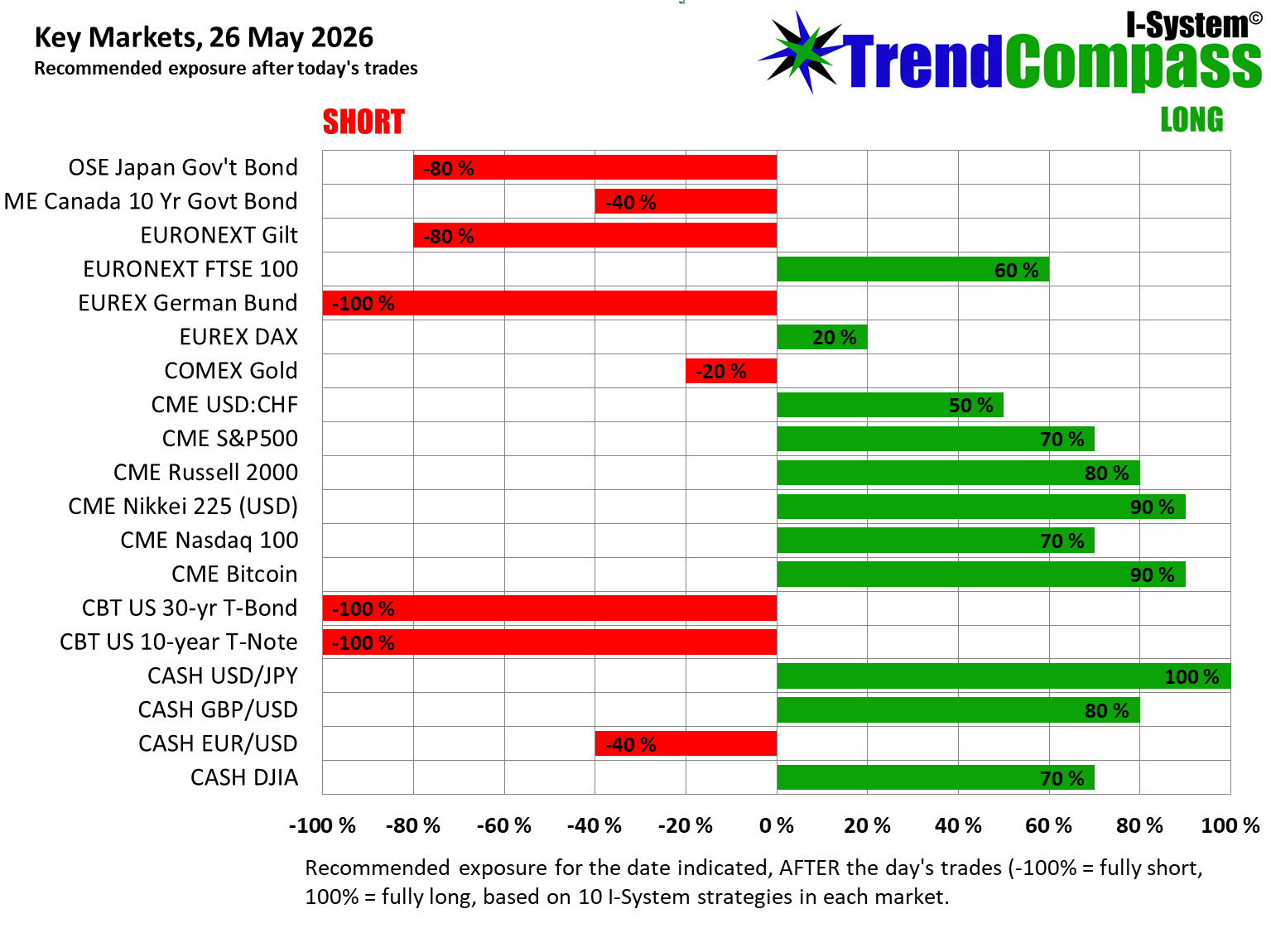
There’s no attachment with today’s report.
Best regards,
Alex Krainer
Love it, very pithy. You have an ability to sort the chaff from the wheat and get to the heart of the matter.
Very interesting, Alex. It's a very fair point. However... anyone inserting Chinese models into their production environment (open-source or not) is taking a chance with hidden and malicious capabilities.