

US capitulates to the Zionist lobby?
Key Markets report for Friday, 5 June 2026

Did the US just capitulate to the Zionist lobby? Not quite yet, but it did take one giant step in that direction: yesterday, the House Armed Services Committee (HASC) advanced its draft FY2027 National Defence Authorization Act, keeping the controversial Section 224 and rejecting the amendment advanced by Representative Ro Khanna to strip it out of the Act. The Section 224, in particular, had strong bipartisan committee support, defended by Committee chairman Mike Rogers and the ranking member Adam Smith.

The title of Section 224 is “United States-Israel Defense Technology Cooperation Initiative.” It is an unprecedented provision that lays out the framework for bilateral research and development, co-production of weapons systems and joint ventures, making the U.S.-Israeli military-industrial complex cooperation seemingly unlimited, covering every area of defence technology including AI, quantum, cyber, biological warfare and directed energy systems. It would effectively turn US military know-how, technologies, data and all future developments fully available to Israel.
It’s not baked in quite yet…
NDAA is not yet law, but it is more likely than not to become law. The next stage in the “democratic” process calls for a debate and amendments in the House of Representatives over the coming days where Thomas Massie will introduce an amendment to strip Section 224 out of the Act. Given that of of 435 members of the House of Representatives, all but ten are recipients of substantial financial support from the AIPAC (American Israeli Political Action Committee), Massie’s amendment will probably be as successful as that of Ro Khanna was in HASC yesterday. The same representatives who periodically treat Israeli PM Benjamin Netanyahu to countless standing ovations in US Congress, will ensure that Section 224 survives the process (minus, perhaps some cosmetic changes for public consumption).
From the House, the new and improved Act will go to the Senate Armed Services Committee for discussion before the vote in both the House of Representatives and the Senate. The NDAA has passed, usually with strong bipartisan support, every year since 1961 (64 consecutive years) as it is considered a “must-pass” act. Once passed, the Act goes to the President, who signs it into law.
The president has veto power over the ACT, but he cannot veto any of its provisions or sections. It’s an all-or-nothing veto: either he signs the entire bill into law, or veto the whole bill and return it to Congress with objections. Thus, if Section 224 remains in the NDAA, President Trump will almost certainly sign it into law (alternatively, he allow it to become law without his signature, if he’s worried about posterity and his legacy. The whole process will not be finalized before October and most likely the 2027 NDAA will become law before the end of December 2026.
The implications of Section 224
Section 224 is nothing short of astonishing. If fully enacted, the US will grant a higher level of military-industrial integration to Israel than it has provided to any other allied power in history. It would effectively merge the U.S. and Israeli defense sectors in multiple areas of military development while while vastly enhancing Israel’s already extraordinary influence in U.S. politics including its participation in Israel’s war and directing the development of the U.S. economy increasingly toward military objective.
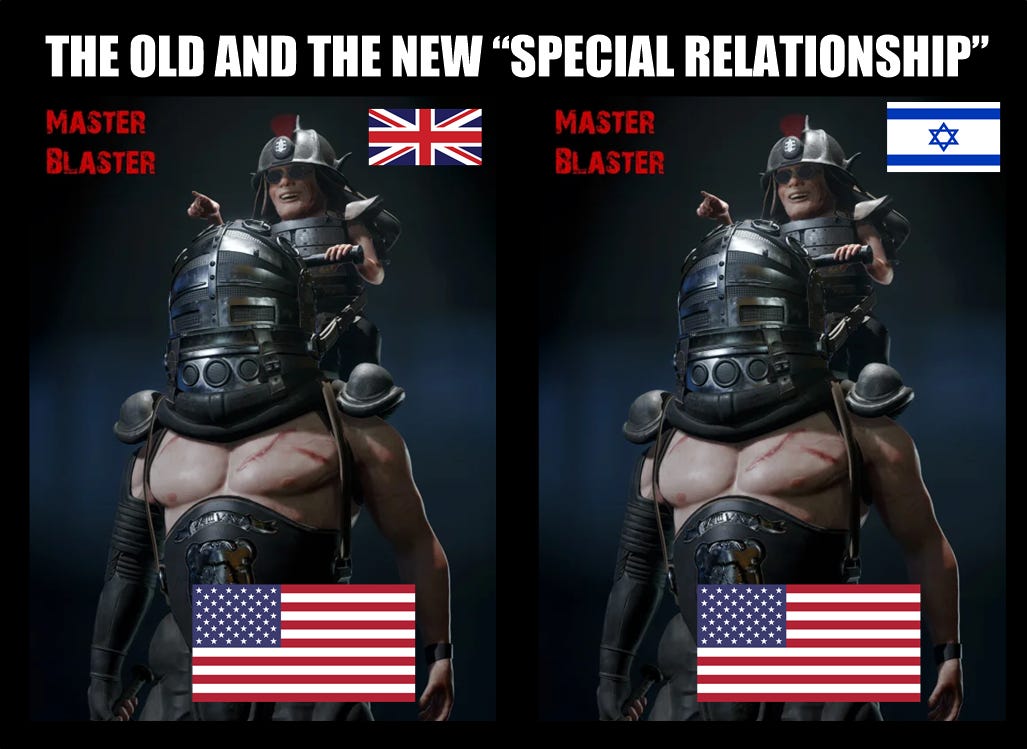
This all could be particularly ominous as Israeli interest seem to be spreading their influence worldwide, in places like South America, Cyprus, Greece, Albania, India, Thailand and Ukraine and at the time when more and more politicians and corporate leaders are talking about instituting the draft and conscripting young people into the armed forces. In not too distant a future, ordinary Americans could find themselves fighting Israel’s wars that have nothing to do with them, their nation or their lives.
This could commit the United States to a new era of enhanced, more aggressive imperial wars with all its ugly consequences, including further evisceration of the U.S. economy and fiscal position. But for ever action there’s a reaction. It remains to be seen whether the American public will accept this, and if not, how determined they will be rejecting it. Israel is not popular in the US these days - it’s less popular than it ever was and the NDAA puts the American political class sharply at odds with the people they supposedly represent.
To learn more about TrendCompass reports please check our main TrendCompass web page. We encourage you to also have a read through our TrendCompass User Manual page. For U.S. investors: an investable, fully managed portfolio based on I-System TrendFollowing is available from our partner advisory (more about it here).

Today’s trading signals
With yesterday’s closing prices we have the following changes for the Key Markets portfolio:
