

US-Iran peace deal: 39th time's the charm!
Key Markets report for Monday, 15 June 2026

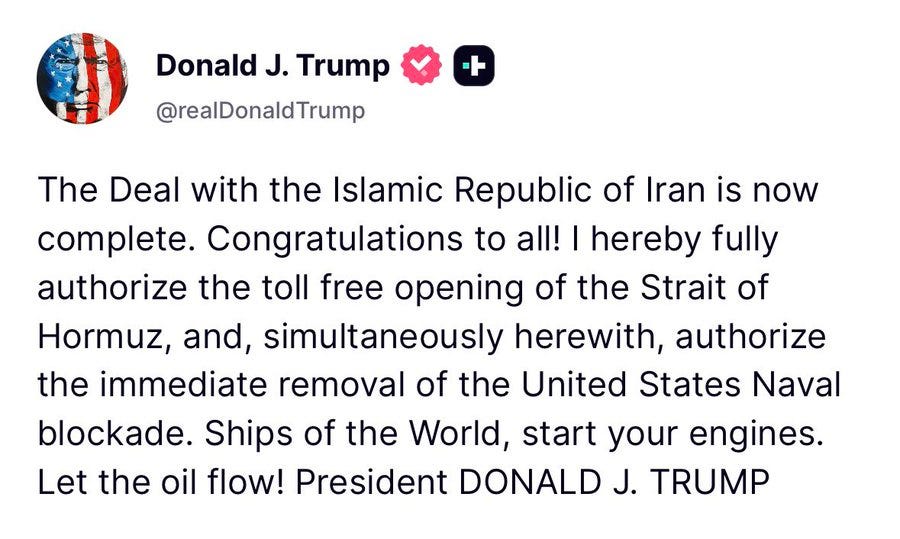
We had another news-packed weekend as has become a norm now. Yesterday, on 14 June 2026 on the occasion of his 80th birthday, President Donald Trump announced the deal between the US and Iran “complete,” confirmed the end of hostilities, and authorized the lifting of the US naval blockade for the full, “toll free” reopening of the Strait of Hormuz to all traffic. Of course, Trump’s news was announced via TruthSocial:
The markets reacted almost as though Trump’s announcement entailed a definite cessation of all hostilities and the “deal” a full peace treaty. This would not be the first time that Trump worded his announcement to strike over-optimistic tones. The “deal” only refers to a 14-point memorandum of understanding (MOU) negotiated through Pakistani mediators. The MOU itself is only a framework to negotiate the end of the conflict and future talks about Iran’s nuclear program and the end of sanctions.
The fourteen points
Furthermore, the deal, which Trump announced as “complete” has only been scheduled for signing on Thursday, 19 June 2026. This is four long days from today, and a lot could change in four days, particularly given that nowhere did President Trump or anyone in his administration refer specifically to the 14 points of the MOU. The 14 points, as the Iranians (and Pakistani mediators) understand them are as follows:
Immediate and permanent cessation of hostilities on all fronts, including Lebanon.
U.S. commitment to non-interference in Iran’s internal affairs and respect for the national sovereignty of the Islamic Republic of Iran.
Full lifting of the naval blockade within 30 days.
U.S. commitment to withdraw its military forces from Iran’s vicinity.
Reopening of the Strait of Hormuz within 30 days, governed by Iranian security arrangements.
Suspension of sanctions on the sale of oil, petrochemical products, and derivatives, along with granting Iran full access to its financial resources.
Reconstruction assistance: The United States and its allies must provide reconstruction plans for Iran totaling a minimum of $300 billion.
A 60-day negotiation window to reach a final agreement on Iran’s nuclear program and the comprehensive repeal of primary and secondary U.S. sanctions.
Iran reiterates its commitment to the Nuclear Non-Proliferation Treaty (NPT).
The U.S. commits to refrain from imposing new sanctions and increasing its troop levels in the region during the negotiation window.
The US must release $24 billion in blocked Iranian funds. Half of this amount must be made available immediately and half within the 60-day negotiation period.
Establishment of a monitoring mechanism to oversee the implementation of the agreement.
UNSC Endorsement: The final agreement shall be ratified by a United Nations Security Council resolution.
Preconditions and Scope: Final negotiations will not commence until half of the frozen assets are released, oil sanctions are suspended, and the naval blockade is lifted. The final agreement will be strictly limited to the status of enriched materials and enrichment activities, the lifting of sanctions, and the economic reconstruction program. Crucially, discussions regarding Iran’s missile program and its support for resistance groups have been definitively removed from the agenda.
Again, nobody in the Trump administration referred to these specific points, let alone affirmed that the US has accepted them as part of the mutually agreed framework for negotiations with the Iranians. This could be very significant because some of the provisions, particularly those under 4, 5, 7 and 11 read like an explicit admission of defeat on the part of the US and something of a humiliating climbdown by Trump himself whose terms for ending his war against Iran included full and unconditional surrender.
We’ll totally obliterate them - maybe.
When Trump announced the Operation Epic Fury on 28 February, he laid out his terms:
“We are going to destroy their missiles and raze their missile industry to the ground. They’ll be - again - totally obliterated. We’re going to annihilate their navy; we’re going to ensure that the region’s terrorist proxies can no longer destabilize the region or the world and attack our forces and no longer use their IEDs or roadside bombs as they are sometimes called to so gravely wound and kill thousands and thousands of people, including many Americans.
And we will ensure that Iran does not obtain a nuclear weapon. … To the members of the Islamic Revolutionary Guard, the armed forces, and all of the police, I say tonight you must lay down weapons and have a complete immunity, or in the alternative, face certain death.”
Furthermore, the inclusion of Lebanon in point 1 makes Israel part of the peace equation: not only must Israel cease bombing Lebanon, the IDF must also fully withdraw from the Lebanese territory.
The predictable spoiler
Members of the Israeli cabinet have explicitly denounced the agreement and the Israeli media reactions have been borderline hysterical. Defense Minister Israel Katz declared that the IDF would stay in Lebanon, Syria and Gaza indefinitely, that the contact villages would be destroyed above and below ground and the residents cleared out entirely. Prime Minister Netanyahu confirmed this directly to Trump only hours after Trump announced the “deal:” Israel will not withdraw from a single position.
Finance Minister Bezalel Smotrich issued a warning to all 400,000 Shiite residents of the Bekaa that any Iranian fire triggers an automatic strike on their homes within the hour. In fact, Israeli reactions have been as expected, suggesting that Israel is the main obstacle to peace. That, furthermore implies that any “deal” between Iran and the US depends on whether the US can muzzle their Middle Eastern ally, and the question is not whether the US is capable of doing so, but whether any leader in the US has sufficient political strength to restrain Israel.
This makes peace in the Middle East very much a US internal political struggle where the actual relationship between the US and Iran and their ability to come to terms comes secondary. President Trump will obviously be keenly aware of all this, which means that the “congratulations” part of yesterday’s announcement was at best premature. At worst, it might have been yet another clever ploy to talk down the oil markets and interest rates and to give a boost to equity prices. For their part, the markets seem to be obliging - again!
They will never give up
Longer term, however, I still find it hard to be optimistic about any agreement that might be reached between the US and Iran. The conflict between them isn’t about the Strait of Hormuz, about Iran’s nuclear program, their ballistic missiles or about the rights of “women and girls” in Iran. The conflict is about capturing political control over Iran, their independence, and their estimated $35 trillion in natural resource wealth.
The Iranians will never be allowed to manage their economic affairs independently, set out their own trade terms or formulate their own monetary system. Western system of governance demands colonial submission to Western financial centers. Imagine the optics if some independent nation suddenly demanded to be paid in gold or silver for their export trade. What might other nations with large balances of paper fiat think? That they can just ask for a different settlement mechanism? This can’t be allowed.
They can NEVER leave independent-minded nations in peace to manage their own affairs unmolested. They might retreat, regroup and prepare the ground for another attempt at destabilizing Iran and toppling its government. The same will apply to Russia, Belarus, Cuba, Bolivia, Burkina Faso, Niger, Mali and any other nation brazen enough to claim sovereignty and independence. President Trump might like to cut his losses with Iran and shift his attention to greener pastures, like Cuba, perhaps.
However, this issue transcends the Trump presidency; it is systemic; with or without Trump, the system will not relent and it will not change until it’s been outright defeated and today nobody in the US has the kind of political capital to even begin defeating the system. Even powerful adversaries like Russia, China and Iran can only begin to beat it into a retreat. But defeating it remains a long way away.
To learn more about TrendCompass reports please check our main TrendCompass web page. We encourage you to also have a read through our TrendCompass User Manual page. For U.S. investors: an investable, fully managed portfolio based on I-System TrendFollowing is available from our partner advisory (more about it here).

Today’s trading signals
With Friday’s closing prices we have the following changes for the Key Markets portfolio:
