

A breakthrough in the Middle East?
Key Markets report for Monday, 22 June 2026

The US and Iranian delegations met at the Bürgenstock resort near Lucrene lake in Switzerland yesterday, in order to commence peace negotiations within the framework of the Memorandum of Understanding (MOU) both sides agreed to last week. The talks got off to a rough start. The Iranian delegation arrived fashionably late, kept the US delegates waiting, then warmly greeted the Pakistani Prime Minister Shebaz Sharif while entirely ignoring US representatives - Vice President Vance, Jared Kushner and Steve Wytkoff.
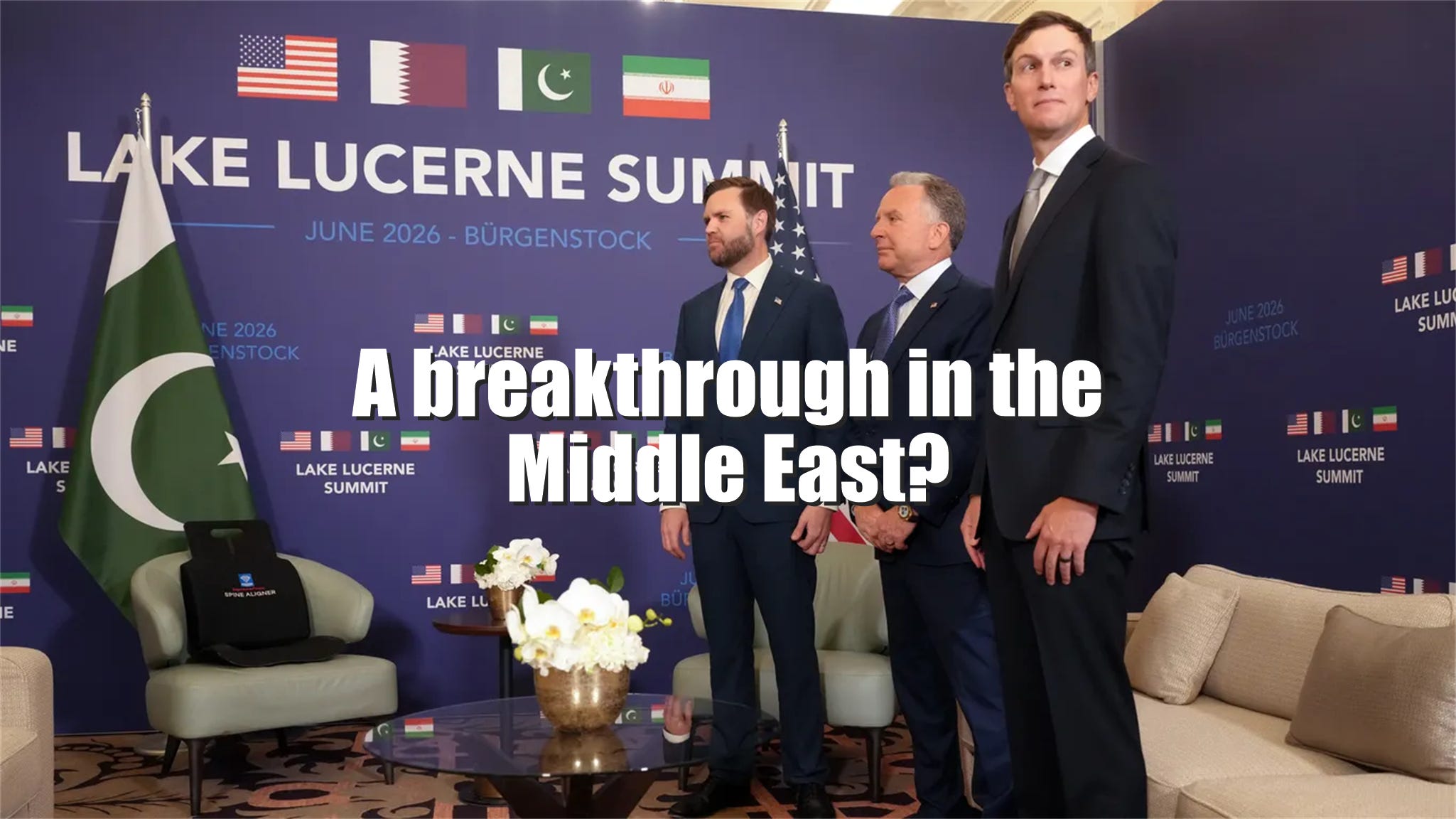
A well-chosen moment for trash talk
Back in Washington DC, President Trump thought it would be a good time to engage in some vulgar trash-talk and threaten the Iranians:
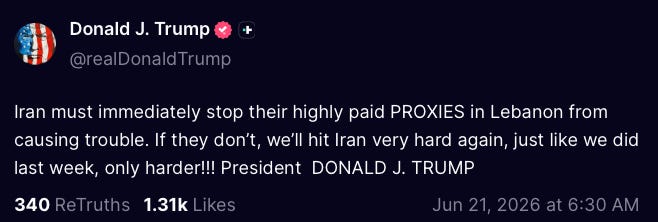
Trump added further insults and threats in various statements and an interview with FOX News. Among other things, he said that if the Iranians closed the Strait of Hormuz, they “won’t have a country,” threatened further bombing and U.S. military action to “take over” the strait, impose US tolls, and in a message to the Iranian delegation said, "You won't even make it back to your fu@#ing country."
Beyond being gratuitously vulgar and unnecessary, Trump’s threats were also a breach of the MOU signed by both sides just last week. The MOU explicitly states that Iran and United states “undertake from now on… to refrain from the threat or use of force against each other…” Besides, issuing death threats to your negotiating partners if they don’t accept your deal just isn’t a very nice thing to do. Understandably, the Iranians weren’t amused: they broke off the talks immediately and reconfirmed the closure of the Strait of Hormuz (they had already announced the closure on Saturday 20 June due to Israel’s continued attacks on Lebanon).
All sides (except one) want peace
Thankfully, the Iranian delegates didn’t immediately leave Switzerland and remained open to indirect talks through Pakistani and Qatari mediators. According to the latest reports, before leaving Switzerland they have agreed to establish a deconfliction mechanism with the US, including for Lebanon, to ensure that hostilities don’t spin out of control.
This, coupled with the fact that the Iranians haven’t slammed the door shut to negotiations, could be a genuine breakthrough between Iran and the US and, at this time, our best indications that beyond the trash talk and the brinkmanship, all sides desire an end to hostilities (all sides including the Persian Gulf kingdoms).
All sides,that is, except for Israel. The events, as they’ve been unfolding, are now clearly singling out Israel as the sole obstacle to peace in the Middle East. They are also singling out Benjamin Netanyahu and his cabinet as the key obstacles within Israel. As a result, a real rift seems to have emerged between the Trump administration and the Netanyahu government. The Iranians are not oblivious to this and they will likely seek to exploit this rift to further isolate and weaken Israel.
Judging by the reactions from Israeli government officials and the media, the indignation about Trump’s “betrayal” and the anxiety about Israel’s position are very real. At the very least, the developments now jeopardize Benjamin Netanyahu’s political future, although it’s unlikely that his departure would turn Israel into a peacenik nation. In 78 years of its existence, Israel has not put forth a single peace proposal to any one of their neighbors. As far as they are concerned, it’s war later, or war now.
The nation that fears peace
Back in March, Tucker Carlson interviewed former speaker of the Knesset and interim President of Israel, Avram Berg who conveyed Israel’s bellicose nature in compelling terms. Berg said that for Israel, there is no such thing as a win-win situation; “we have to hurt, humiliate all adversaries and everyone is an adversary.” Israel, in Berg’s view doesn’t even have the vocabulary of peace, and as the country grew more powerful over decades, it has also grown less secure and feeling ever more threatened. Going to war was often a matter of opportunity, rather than necessity.
However, Berg said that Israel fights its wars without a strategy - that the nation doesn’t have a strategy. Instead, military is used like a hammer and every perceived threat to the nation’s security like a nail. During their discussion, Mr. Berg suggested to Carlson that Iran must have nuclear weapons to protect itself from Israel, but that the prerequisite of peace in the region should be a nuclear-free Middle East, including Israeli nuclear weapons.
At least the markets seem happy
According to the latest reports this morning, the Strait of Hormuz remains closed, at least partially: while some 35 ships passed the Strait on Saturday (21 June), only 12 vessels transited yesterday. This is less than a tenth of the prewar levels suggesting that the crisis still represents a heavy drag-factor on the global economy. In spite of the good news - that all sides are working toward peace - the uncertainty remains.
One of the most puzzling aspects of the Hormuz crisis might be how the markets are reacting to it: bad news are good news, and good news are also good news. The Iranians closed the Strait of Hormuz on Saturday so naturally, the price of oil is down more than 2.5% in this morning’s trading. Equity markets are up again trading less than 1% below their all-time highs. That brings me back to my 2019 prediction, which has aged exceptionally well.
Namely, in my November 2019 article, The one force moving stock prices and what it tells us about the future, the specific prediction was this: “the endgame: an accelerating bull run accompanied by hyperinflation after which comes an epic crash." Although we are not in a hyperinflation by a long shot, the accelerating bull run is pretty much what we had since 2019. Here’s Nasdaq’s weekly chart:
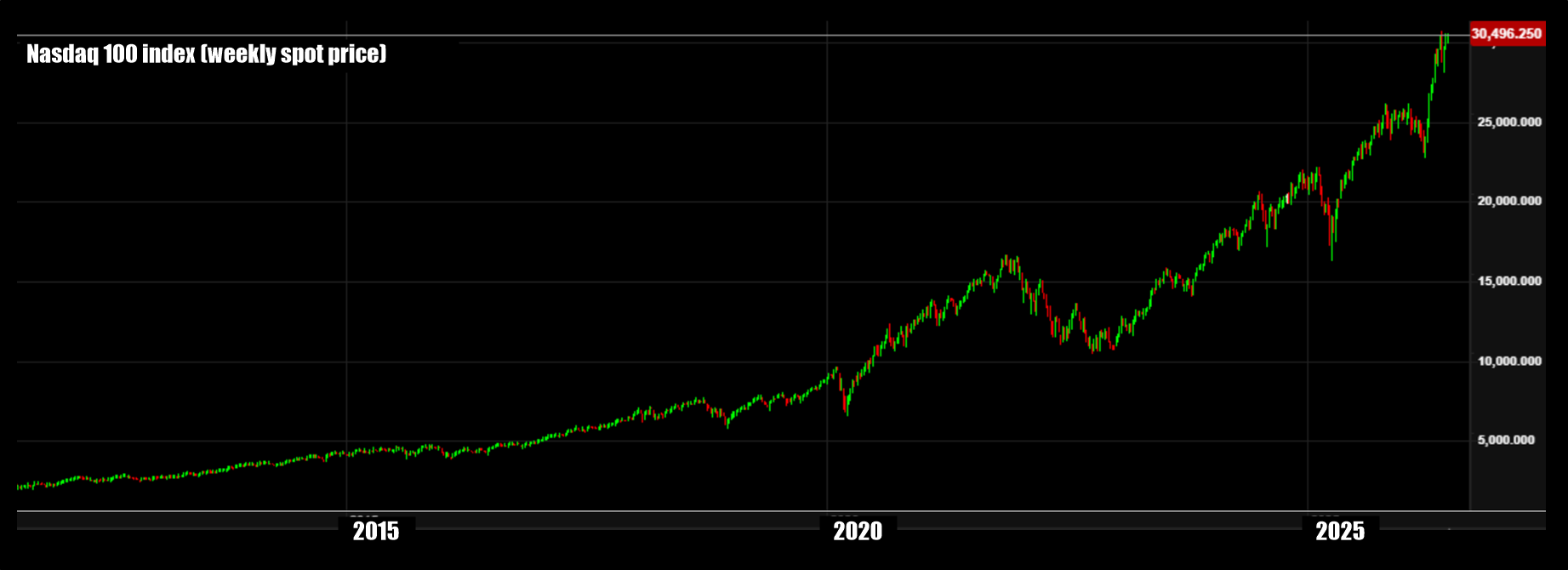
So far as Nasdaq’s acceleration is concerned, it would appear that we have now entered the vertical climb stage which could continue to rise and it would be pointless to use valuation metrics to determine how high this climb could reach. Over the past ten or 15 years, valuation metrics caused many analysts to call the top and predict an epic crash prematurely. At the same time, what is quite obvious from the above chart is that markets move in trends, reconfirming again our core hypothesis that trends are far and away the most powerful drivers of investment performance.
To learn more about TrendCompass reports please check our main TrendCompass web page. We encourage you to also have a read through our TrendCompass User Manual page. For U.S. investors: an investable, fully managed portfolio based on I-System TrendFollowing is available from our partner advisory (more about it here).
Today’s trading signals
With Friday’s closing prices we have the following changes for the Key Markets portfolio:
