

Oil price collapse makes no sense
Key Markets report for Friday, 3 July 2026

Somehow the price discovery process in crude oil market doesn’t pass the smell-test:
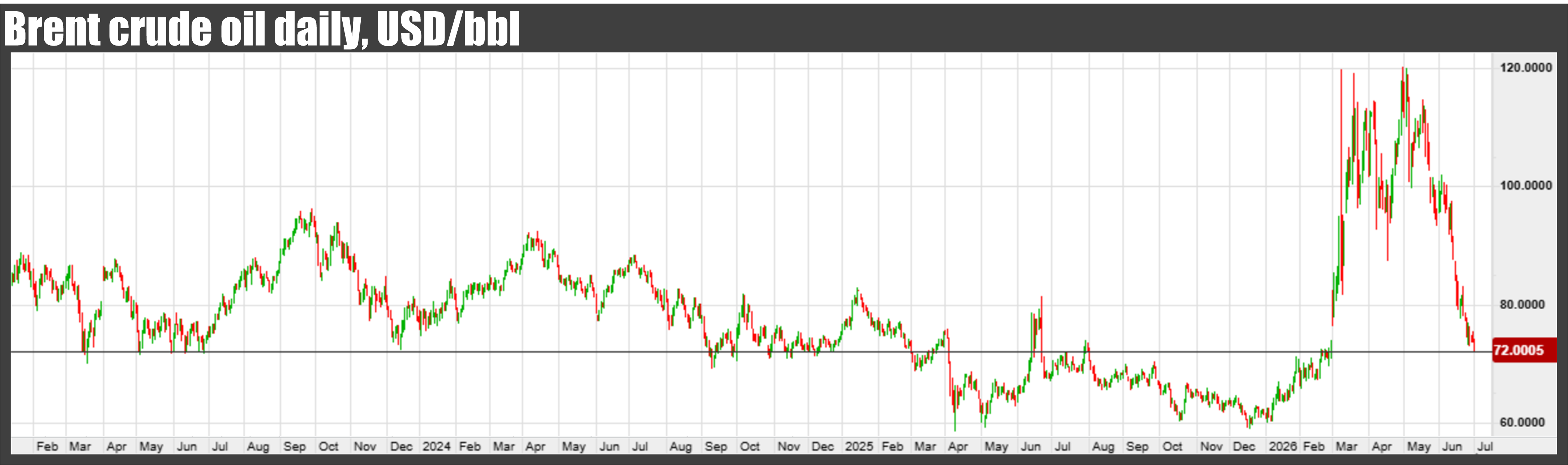
After peaking at $125 four years ago, the price of a barrel of Brent crude oil spent about two years fluctuating around $80, then gradually declined until it bottomed just below $60. Then came 28 February 2026 when the US and Israel attacked Iran. As was widely expected, Iran responded by closing the Strait of Hormuz which was the greatest oil market disruption in oil market’s entire history. The market reaction was a near doubling of the price of oil.
However, after peaking at $120/bbl, the price collapsed back to low $70s as though the markets went back to normal conditions before the war. Only, that’s not what happened: the traffic through the Strait of Hormuz is still drastically reduced, much of the strait is mined, and Iran continues to impose its own control and restrictions on the passage of maritime traffic. In spite of this, the market seems to have factored in a level of optimism that’s completely unwarranted by the facts of the ground. Here are some of the consequences of the Hormuz disruption:
Global oil inventories are at the lowest levels ever seen for this time of year
We have moved from a 177 million barrel surplus before the war to a 141 million barrel deficit relative to the five-year average
Total inventory draws since the conflict began reached 430 million barrels, creating a 508 million barrel divergence compared to last year.
US commercial oil inventories now sit at their lowest level since at least 2016.
Gasoline and distillate stocks show clear shortages in key regions.
Refinery crack spreads for gasoline and diesel have hit all-time highs, up 182 percent year to date, signalling strong underlying product demand and clearly contradicting downward price action
US strategic petroleum reserves have fallen to 325 million barrels, the lowest level since June of 1983. Oil analysts regard 300 million barrels as a practical floor the market cannot breach without very serious consequences.
One way the apparent contradiction between the price discovery process and facts on the ground could be explained is that in periods of extreme uncertainty, markets tend to overreact in either direction. Recall, at the start of the Covid 19 pandemic, oil prices collapsed toward zero, allegedly even recording negative values at one point.
Trends are still the best navigation compass
Truth be told, oil prices soared and collapsed as sustained trends and our trend following strategies navigated this period quite well. As a trend follower I can’t complain, but the idea that the price discovery process seems to be discounting an alternate reality is quite disconcerting. At this stage, the level of volatility and uncertainty could begin to induce motion-sickness in anyone too absorbed in the unfolding events and the price charts.
Perhaps the best advice I could offer to market participants at this point is to continue to adhere to trend following strategies, but to scale back risk and have as much financial cushion to absorb adverse price movements until violatility reverts to normal levels.
Independence day holiday in the US
Please note, US markets will be closed today, so today’s trades should be executed when the markets reopen on Monday. Monday’s report will be a shortened version, showing only the trading signals for non-US markets, if any. To our American subscribers we wish a happy Independence day and a pleasant weekend of celebrations.
To learn more about TrendCompass reports please check our main TrendCompass web page. We encourage you to also have a read through our TrendCompass User Manual page. For U.S. investors: an investable, fully managed portfolio based on I-System TrendFollowing is available from our partner advisory (more about it here).

Today’s trading signals
With yesterday’s closing prices we have the following changes for the Key Markets portfolio:
