

Are new & improved lockdowns coming?
Key Markets report for Friday, 21 November 2025

Yesterday The Telegraph published an article about the Right and Honourable Baroness Heather Hallett DBE’s 1,531-page COVID-19 inquiry which concluded that 2020 lockdowns could have been “avoided entirely” had the government imposed “stringent restrictions” such as social distancing and face masks sooner and more decisively. By the way, for anyone impressed by Ms. HH’s nobility, know that you too can be a noble. You can buy the title of baron or baroness at this link.
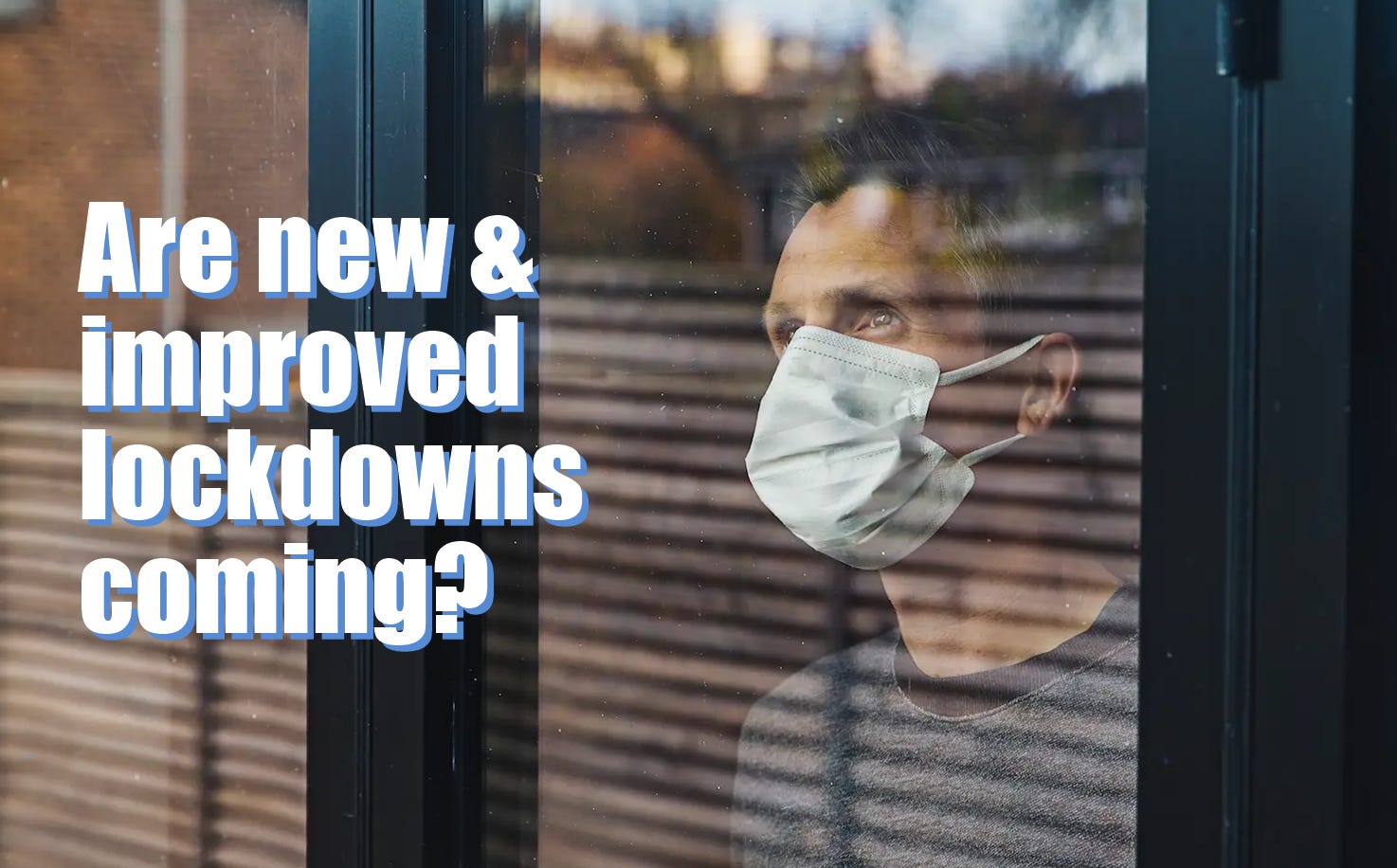
Here’s the gist of Ms. HH’s conclusions:
“Had stringent restrictions short of a mandatory lockdown been introduced earlier than March 16th 2020 – when the number of COVID-19 cases was lower – the mandatory lockdown might have been shorter or, conceivably, avoided entirely. … At the very least, there would have been time to establish what the effect of those restrictions on levels of incidence were and whether there was a sustained reduction in social contact. This would have enabled the governments to assess whether stringent restrictions short of a lockdown would suffice to prevent health services across the UK being overwhelmed and whether they were therefore a feasible policy option.”
The right and honourable baroness quoted Mark Woolhouse, a Professor of Infectious Disease Epidemiology at the University of Edinburgh, who told the inquiry that “more proportionate and sustainable interventions” such as contact tracing, self-isolation, face coverings and respiratory hygiene, should have been introduced “as early as March 4th 2020.”
An inquiry or a plan?
If we condense the above conclusions a bit further, it turns out that “the mandatory lockdowns might have been shorter” had “more proportionate and sustainable interventions” like contact tracing, self-isolation, face coverings and respiratory hygiene (?) been introduced much earlier. More than five years after one of the worst ___________ (fill in the blank) in human history, Ms. Hallett’s inquiry wasn’t focused on who should spend the rest of their lives in prison, but why the whole project failed.
The noble Ms. HH thought that the government should have been quicker, less hesitant and more rigorous about implementing restrictions, but her inquiry somehow missed the fact that neither social distancing nor face masks had any science-based merit as effective pandemic countermeasures. Regardless, had these dubious measures been put in place before 16 March 2020, lockdowns might have been of shorter duration (she forgot to specify by how much).
The baroness faults the government for implementing measures that were “too little, too late,” due to a “toxic and chaotic culture.” Had they acted more decisively, 23,000 lives could have been saved. Knowing how deeply our governments care about saving lives, they will surely jump without any hesitation at the opportunity to correct the errors of their ways by doing too much, too soon when the next pandemic rolls around.
Are pandemics even a thing?
The answer to that question is not clear. Over the last five years I’ve participated in weekly 2-hour Zoom calls of a group called “Medical Doctors for Covid Ethics,” which gathered many of the world’s most eminent scientists including doctors, virologists, epidemiologists, molecular biologists, public health officials, pathologists, and data scientists. Presentations were delivered by individuals like Peter McCullough, Robert Malone, Jay Battacharia, Carrie Madej, Sucharit Bhakdi, Roger Hodkinson, Pierre Kory and many others with extensive discussions following these presentations.
On the basis of one such presentation by data scientist Craig Pardekooper, I published an article that’s among the most important ones I ever wrote:

My point in mentioning these Zoom calls is that this gathering of highly authoritative experts isn’t in an agreement about whether “pandemics” are even a thing. Local epidemics of infectious diseases do periodically erupt and may spread across multiple regions. However, there are strong reasons to doubt whether worldwide pandemics are biologically possible at all.
In spite of those doubts and absence of a scientific consensus, other experts like Bill Gates, Anthony Fauci, Albert Bourla and Tedros Gheberyesus have assured us for years that, not only are pandemics a thing, the next one might strike at any moment and it could be much worse than Covid. So please, even though the thing may be as real as monsters under your bed, out of an abundance of caution, do stay very afraid and ready to comply with whatever is coming next.
Out of that abundance of caution and a sincere concern about saving up to 23,000 lives (duh, obviously), our governments may be preparing to do too much, too soon to protect us the next time.
What’s the next pandemic?
It may be that like the last pandemic, the next one could originate in the banking sector. Earlier this month, I detailed how the COVID 19 pandemic coincided with a gathering collapse in the banking sector. For anyone who missed it, the article is linked beow:
ECB soils self
Earlier this week, the ECB issued a warning that Euro zone banks must prepare for unprecedented shocks causing severe disruptions with far-reaching consequences for financial systems, the European Central Bank said on Tuesday as it outlined its supervisory priorities for the next three years. This is very unusual: banks, especially central ones, usually go out of their way to reassure us that the system is sound, there’s nothing to worry about and we can safely disperse: nothing to see here.
Now they appear to have soiled themselves for some reason (liquidity drying up + a shortage of high quality collateral since the selfish Russians won’t let us have their natural resources). This is probably where that “next pandemic” is brewing up and why it may be necessary to go hard and fast with lockdowns 2.0
We’ve been in a health emergency for 10 weeks now!
It may also be why back in September, European Commission President, the crooked and dishonourable Ursula von der Leyen thought it appropriate to announce in her State of the Union speech before the EU parliament that “We are on the brink, if not even at the start of another global health crisis.” If that was true (of course it was, Ms. von der Leyen wouldn’t lie to us about important things like that!), we’ve been in a new global health crisis for over 10 weeks now.
It may be that the contagion from the ECB, BOE, BOJ and the Fed could begin to spread rapidly, necessitating urgent and “stringent” measures. The consequences could be similar to early 2020, including major dislocations in global financial and commodities markets. Studying the price charts of gold, silver, copper, crude oil, currency pairs, treasury bonds, and equity markets could provide valid guidance for the next “pandemic.”
However, the more radical measures this time could include even closure of markets and banks that could last days, weeks or months (as in the UK after the breakout of World War I). The troubling part is that this will probably have to be a complete ambush: they won’t be able to preannounce their measures in advance, implying that we have to prepare before the proverbial excrement hits the fan, with adequate amounts of cash on hand, non-perishable foods and fuel for heating and transport. It is entirely possible that the Internet might go down to prevent the spread of misinformation and disinformation too.
To learn more about TrendCompass reports please check our main TrendCompass web page. We encourage you to also have a read through our TrendCompass User Manual page. For U.S. investors: an investable, fully managed portfolio based on I-System TrendFollowing is available from our partner advisory (more about it here).
Today’s trading signals
With yesterday’s closing prices we have the following changes for the Key Markets portfolio:
