

Bubbles and crashes
Key Markets report for Thursday, 4 June 2026

Over the last few days, as US equity valuations eased slightly from their all time highs, the story that won’t go away is the AI effect which increasing looks like a buble. Out of Nasdaq’s total market cap, which is now nearly $40 trillion, the big tech “Magnificent 7,” like Nvidia, Apple, Microsoft, Amazon, Google, Meta and Tesla account for almost 60% of the total index weight. Most of them got inflated with the AI hype, but over the recent weeks, the hype has been giving way to more sober concern over valuations and the risk of the bubble bursting - perhaps a bigger and badder rerun of the 2000 dotcom bust.
A premature short
Last month I posted a few articles about AI itself and its flaws, but the increasingly pervasive talk of AI bubble bursting reminded me again of Stanley Druckenmiller’s story which could once more become a relevant warning for investors to heed. As the dot-com bubble inflated relentlessly through the late 1990s, Druckenmiller understood that the technology stocks were dramatically overvalued. Accordingly, he accumulated a large short position in many internet ventures well ahead of the market crash. But as stock prices advanced over the following months, his positions were generating painful losses.
At the same time, Druckenmiller’s younger peers had aggressively piled into the tech stocks, and for a while the markets rewarded them with spectacular returns, each month reaffirming the prevailing groupthink that, “this time it’s different.” Eventually, Druckenmiller lost his nerve, closed out his short positions and went long the tech stocks - literally hours before the Nasdaq peaked. Once it did peak, what followed was an epic bust during which 75% of Druckenmiller’s original shorts went bankrupt while the rest sustained losses of between 90% and 99%. But instead of having a banner year, Druckenmiller lost half of his $6 billion fund in only a few weeks’ time.
How Nasdaq crushed Druckenmiller
At a 2015 event[1] where he gave a keynote speech, Druckenmiller was asked what he thought the biggest mistake of his career was and what he’d learned from it. His remarks are highly illuminating:
“… in 1999 after Yahoo and America Online had already gone up like tenfold, I got the bright idea at Soros to short internet stocks. And I put 200 million in them in about February and by mid-March the 200 million short I had lost $600 million on, gotten completely beat up and was down like 15 percent on the year. And I was very proud of the fact that I never had a down year, and I thought well, I’m finished.
So the next thing that happens is I can’t remember whether I went to Silicon Valley or I talked to some 22-year old with Asperger’s. But whoever it was, they convinced me about this new tech boom that was going to take place. So I went and hired a couple of gun slingers because we only knew about IBM and Hewlett-Packard. I needed Veritas and Verisign. … So, we hired this guy and we end up on the year – we had been down 15 and we ended up like 35 percent on the year. And the Nasdaq’s gone up 400 percent.
So I’ll never forget it. January of 2000 I go into Soros’s office and I say I’m selling all the tech stocks, selling everything. This is crazy. [unintelligible] This is nuts. Just kind of as I explained earlier, we’re going to step aside, wait for the next fat pitch. I didn’t fire the two gun slingers. They didn’t have enough money to really hurt the fund, but they started making 3 percent a day and I’m out. It is driving me nuts. I mean their little account is like up 50 percent on the year.
I think Quantum was up seven. It’s just sitting there. So like around March I could feel it coming. I just – I had to play. I couldn’t help myself. And three times during the same week I pick up a – don’t do it. Don’t do it. Anyway, I pick up the phone finally. I think I missed the top by an hour. I bought $6 billion worth of tech stocks and in six weeks I had left Soros and I had lost $3 billion in that one play.
You asked me what I learned. I didn’t learn anything. I already knew that I wasn’t supposed to do that. I was just an emotional basket case and couldn’t help myself. So, maybe I learned not to do it again, but I already knew that.”
For years, Druckenmiller delivered remarkable investment returns and built up a personal fortune of over $4 billion. But the hype and emotion of the dotcom bubble got to him. Day after day, he watched the tech stocks skyrocket and his younger and much less experienced colleagues make huge returns while his fund languished. What they were doing was working, and what he was doing was failing. Day after day the markets were telling him that the younger managers were right and he was wrong; that they were smart and he stupid, until he decided to stop worrying and embrace the bubble.
“I was just an emotional basket case and I couldn’t help myself,” said Druckenmiller. This story is relevant for all investors today, buecause as in 1999 and early 2000, valuations hardly make sense, yet the markets are at peak. This could continue and nobody could predict how high stock valuations could rise, or for how long. To my mind, the best way to avoid succumbing to emotion is to rely on trend following.
The one group of investors who did well after the dotcom bubble burst were trend followers. They stayed with the prevailing bullish trend past the peak, but soon reversed to short position and collected another windfall on the way down.
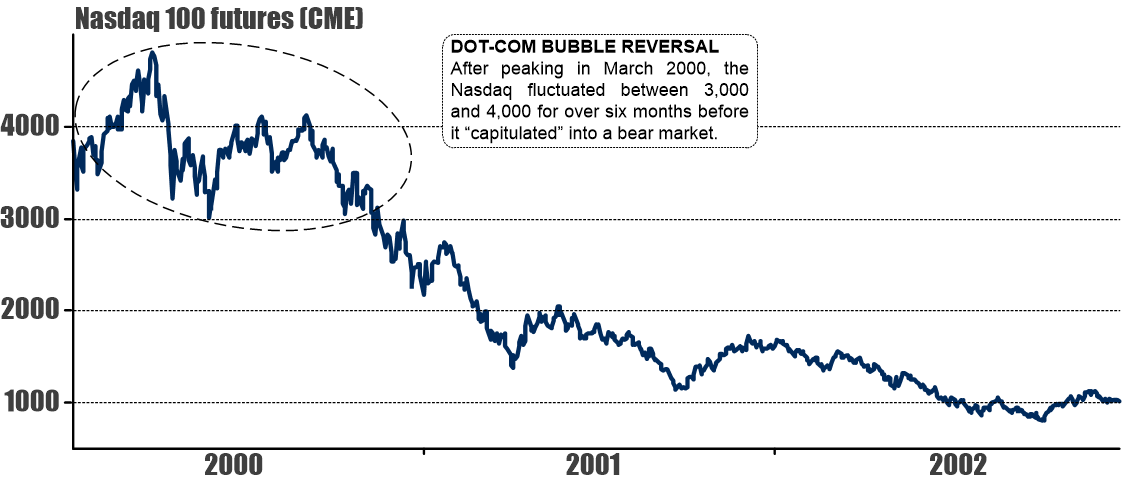
As the above chart shows, the bubble didn’t burst from one day to the next. Instead, we had a fairly orderly double-top reversal signalling that a bear market could follow. Any trend following strategy worth its salt wouldn’t have failed to pick up that signal and sail along with the ensuing bear market trend. Druckenmiller’s fellow market wizard, Paul Tudor Jones came to the same conclusion:
“One thing I have learned over time is that the best thing to do is let market price action guide your decision-making.”
To learn more about TrendCompass reports please check our main TrendCompass web page. We encourage you to also have a read through our TrendCompass User Manual page. For U.S. investors: an investable, fully managed portfolio based on I-System TrendFollowing is available from our partner advisory (more about it here).

Today’s trading signals
With yesterday’s closing prices we have the following changes for the Key Markets portfolio:
