

Escalating geopolitical risks and the looming energy crisis (and opportunities)
Key Markets report for Wednesday, 3 June 2026

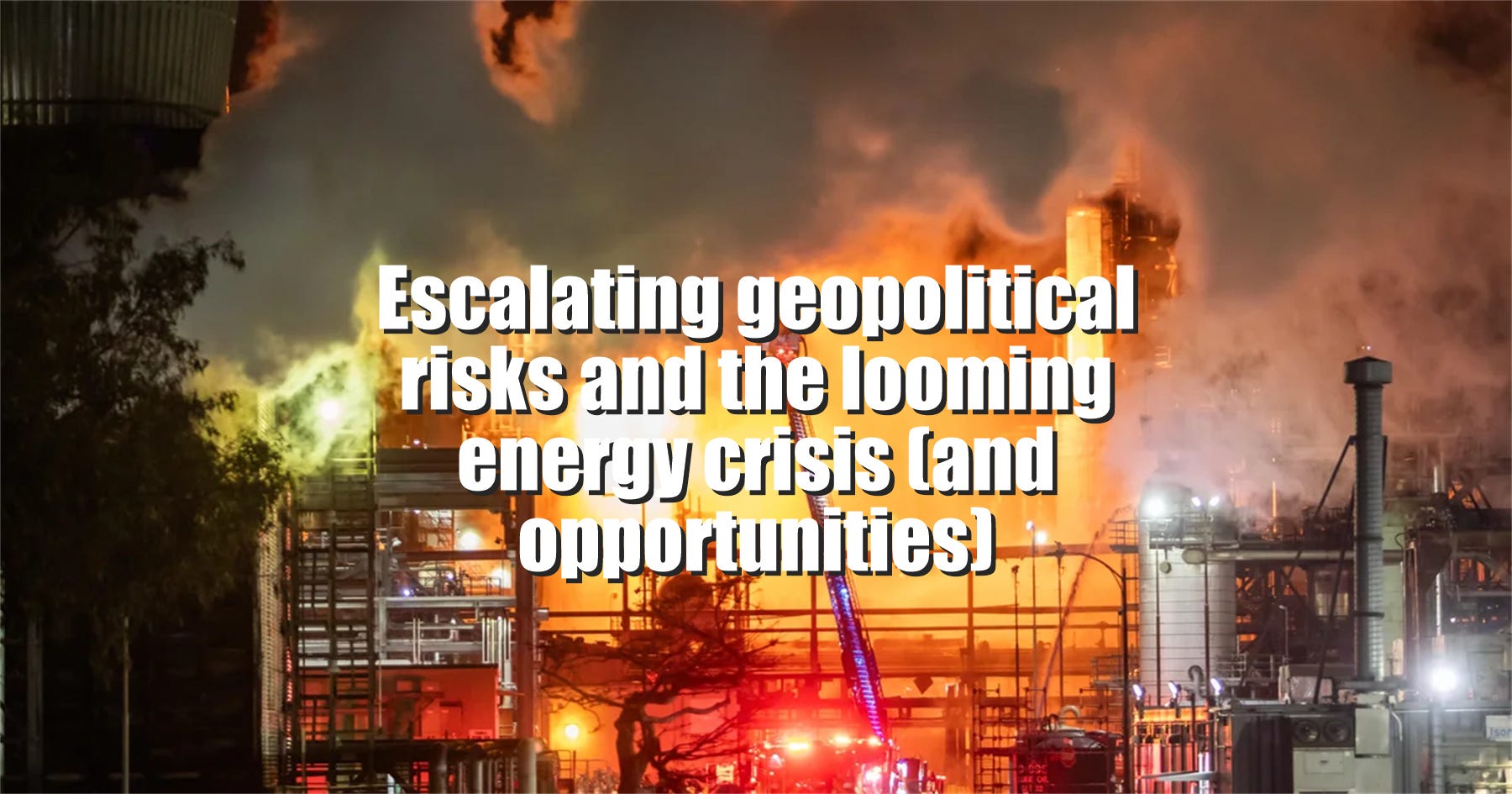
In just the the last few hours, the geopolitical situation has deteriorated markedly toward new, potentially catastrophic military escalations. This morning, coinciding with the opening of the St. Petersburg International Economic Forum (SPIEF), Ukraine carried out drone strikes on St. Petersburg, targeting the St. Petersburg Oil Terminal (a major oil transshipment facility). The strike caused significant damage with fire and black smoke visible from afar. Further strikes hit infrastructure in multiple districts (e.g., Kirovsky, Krasnoselsky), as well as military targets at the Kronstadt naval base with its related facilities.
In Donetsk, a Ukrainian drone struck a civilian bus, killing 7 and injuring 11 people. These attacks aren’t merely an escalation between Ukraine and Russia. It is clear that the drone attacks are backed by Ukraine’s NATO partner nations, almost certainly encouraged and led by Great Britain. As I covered here in the past, Ukraine’s advances in offensive drone warfare rely heavily on European manufacturing and its targeting is facilitated by U.S. based companies like StarLink and Palantir technologies.
Pushing hard for World War III
Recall, on 16 January 2025, Britain’s Prime Minister Keir Starmer travelled to Kiev where he signed a "One Hundred Year Partnership Agreement" with Ukraine. The agreement explicitly addresses drone technologies and defence innovation cooperation, including technology transfer and joint production of drones:
“We will progress Ukrainian and UK capabilities in the development and use of emerging innovative and critical technologies, including digital infrastructure and communications, space, AI and drones – capitalising on Ukraine’s battlefield-expertise and innovation of AI-enhanced drone capabilities in support of the development of civilian applications.”
The agreement spelled out the commitment to “deepening defence industrial cooperation, joint production of defence products, technology transfers, and innovation,” … “in areas such as … drones…” Within the framework of their 100-year partnership, another battlefield technology-sharing agreement was signed in June 2025, focused specifically on drone co-production (UK manufacturing of Ukrainian-designed systems). The manufacturing was also farmed out to facilities in a number of NATO member nations, including Germany, Denmark, Latvia, Lithuania, Netherlands, Poland, Czech Republic, Spain, Turkey and Italy.
In attacking St. Petersburg on the eve of the SPIEF (where President Putin was scheduled to deliver an address to the attendees) and a civilian bus (not the first civilian target struck by Ukraine), Russia is clearly being provoked into escalating the conflict beyond Ukraine’s borders, potentially leading us toward another great war on the European continent - exactly what Britain’s king Charles III called for during his recent address to the joint session of the U.S. Congress. King Chuck’s words are worth remembering for posterity - :
“In the immediate aftermath of 9/11 when NATO invoked Article 5 for the first time, and the United Nations Security Council was united in the face of terror, we answered the call together as our people have done so for more than a century, shoulder to shoulder through two world wars, the Cold War, Afghanistan, and moments that have defined our shared security. Today, Mr. Speaker, that same unyielding resolve is needed for the defence of Ukraine and her most courageous people.”
So far, Vladimir Putin’s restraint and patience has kept the conflict confined to Ukraine, but political pressures on him to take the gloves off and strike at NATO member nations is now growing more and more intense in Russia. If Russia does strike at a NATO member nation, a nuclear exchange becomes very probable.
Meanwhile in the Middle East…
Hostilities have also taken a sharp turn for the worse in the Middle East as Iran’s IRGC targeted US bases in Kuwait, Bahrain and Iraq - a “true promise” retaliation for the recent US attacks on Qeshm Island. Not only have peace talks between the US and Iran been suspended indefinitely, the Iranians are now openly defying the American forces in the region and embarrassing President Trump who might respond by renewing strikes on Iranian targets. The favored targeting options include Iran’s energy facilities and decapitation strikes on their high-level leadership.
If the US strike at Iranian energy infrastructure, Iran’s government vowed that their response will be total obliteration of the energy infrastructure in the whole region. At that point, what has been the worst oil market disruption in history will become considerably worse, removing up to 32% of crude oil supplies from the global markets.
Mind the unexpected surprises
In response to these developments, the barrel of Brent crude oil has jumped from about $94 on Friday to just over $102 in this morning’s trading. It is hard to see how it won’t continue to go significantly higher from these levels, but before jumping into that trade, we have to remain mindful of unexpected surprises and risks that could erupt suddenly and out of nowhere.
Toward the end of 2019, the price of oil was gradually rising toward $70/bbl. However, by mid-April 2020, it dropped to below $20. The last, steepest part of that decline happened as the World Health Organization declared Covid-19 a Public Health Emergency of International Concern and governments around the world imposed unprecedented lockdowns, risking a crash of the global economy.
A few lessons of that episode must be kept in mind: the sudden decline in oil prices started already in January, preceding the lockdowns by over two months. They bottomed about three weeks after the implementation of the lockdowns from which point they began to recover. As I’ve written in this report on a few occasions, it has been apparent since September 2025 that our ruling “elites” are keen on rerunning some kind of a pandemic scare all over again to ambush us with new and improved lockdowns. Even if a plandemic scare fail to take hold, an acute energy crisis could justify similar action over the coming months.
Watch the narrative trends
If the future resembles the past, we should watch for the emerging narrative trends, which will precede any drastic government action. The price of oil could follow that narrative and, before oil prices go higher, they could sustain a sharp decline. This event represents an important source of risk, but also an opportunity. Therefore, any bet on rising oil prices should be played very cautiously with an abundant cash reserve available to take advantage of any unforeseeable oil price crash.
I’m not sure how exactly investors should manage such risks, but the talk among experienced traders seems to be in favor of buying a third to a half of your intended maximum exposure, then adding risk into a major price decline. Supposing your maximum exposure to oil is $10,000, you might go long about $3,500 to $5,000 now, then add when analysts on CNBC and Bloomberg start talking about $10/bbl oil.
How to gain exposure to oil prices
The most direct way to trade energy securities like crude oil, heating oil, gas oil, RBOB gasoline or natural gas is through futures contracts. However, that requires having an account with a futures broker. The issue with futures, however, is that you can only trade in standard size contracts (i.e. minimum 1,000 barrels of crude oil), which requires substantial funding. For some markets, mini contracts are also available, but they tend to be much less liquid than the real thing, to trader’s disadvantage.
For more flexible exposure to oil prices, Contracts for Differences (CFDs) are the easiest and cheapest alternative. However, they are only legal in certain jurisdictions, like UK and EU. In most jurisdictions, the simplest way to play rising oil prices is through liquid, low-cost ETFs with either direct crude oil futures ETFs or energy sector ETFs/stocks (for leveraged operational upside plus dividends).
One of them is the highly liquid United States Oil Fund (USO), which tracks the near-term WTI crude oil futures - it is the most direct ETF bet on oil price moves. Other candidates could include Energy Select Sector SPDR (XLE) or Vanguard Energy ETF (VDE) which hold shares of major oil companies (ExxonMobil, Chevron, etc.).
Options are great for your broker
As I covered in this newsletter in the past, I can’t recommend trading options. Even for professional traders, trading options is a serious challenge that requires considerable expertise, fluency in the 'greeks' and constant monitoring and adjusting of your positions. Under ordinary market conditions, about 1/3rd of all options expire worthless.
But during big market moves, upwards of 90% of all options expire worthless, so the ability to consistently squeeze out profits through options trading requires skillful maneuvering. Not to mention, options are expensive and those costs can add up as you wait for the big rally. As Jason Zweig put it, "I put two children through Harvard by trading options. Unfortunately, they were my broker's children."
To learn more about TrendCompass reports please check our main TrendCompass web page. We encourage you to also have a read through our TrendCompass User Manual page. For U.S. investors: an investable, fully managed portfolio based on I-System TrendFollowing is available from our partner advisory (more about it here).

Today’s trading signals
With yesterday’s closing prices we have the following changes for the Key Markets portfolio:
