

Headwinds are multiplying for Trump
Key Markets report for Wednesday, 22 July 2026
As if the empire’s geopolitical woes weren’t bad enough, it seems that danger signs are popping up all over the place, perhaps most ominously in the financial markets. Equity valuations are levitating near their all-time highs, with a very distinctly bubbly feel to it. This is highly irrational territory, extremely thankless point to make any predictions, but the environment is so fraught with risk that market reactions in whatever direction, are bound to be up ahead.
The collapsing collateral and trade cash flows
US allies in the Middle East are rapidly learning what Henry Kissinger meant when he said that being an enemy of the United States was dangerous, but being a friend is lethal. But the geopolitical aspects of the war will have a substantial financial impact. This may not yet be apparent, and it is not discussed, but it is certainly worsening in terms of the loss of collateral and the drying up of vast cash flows moving from the region’s trade toward Western banking institutions. This all is progressively hollowing out those institutions’ balance sheets and obliging central banks to ramp up the money printing presses.
As we saw in yesterday’s report, the war being fought in the Middle East was meant to also further US attempt to ensure primacy in the Artificial Intelligence sector, but that part of the story isn’t going well either.
Big tech’s secret debts
Another story that exploded this week is related to US Big Tech’s financials. Namely, a Nikkei investigation found that Alphabet, Microsoft, Amazon, Meta, and Oracle have $1.65 trillion in debt that doesn’t appear on their balance sheets, more than the $1.35 trillion they officially report. Their “shadow borrowing” was concealed from the markets and from the public using some of the same accounting gimmicks that had wrecked Enron. The fact that none of the five companies responded to Nikkei’s request for a comment, is not reassuring.
The debts stem from AI-related investments like GPU contracts, data center leases, and joint ventures that don't count as debt under accounting rules until the facilities go live. Meta's hidden debt is $420 billion, triple its reported debt. Oracle's grew 30-fold in four years. In all, these firms’ debts mushroomed 8-fold relative to where it was only four years ago.
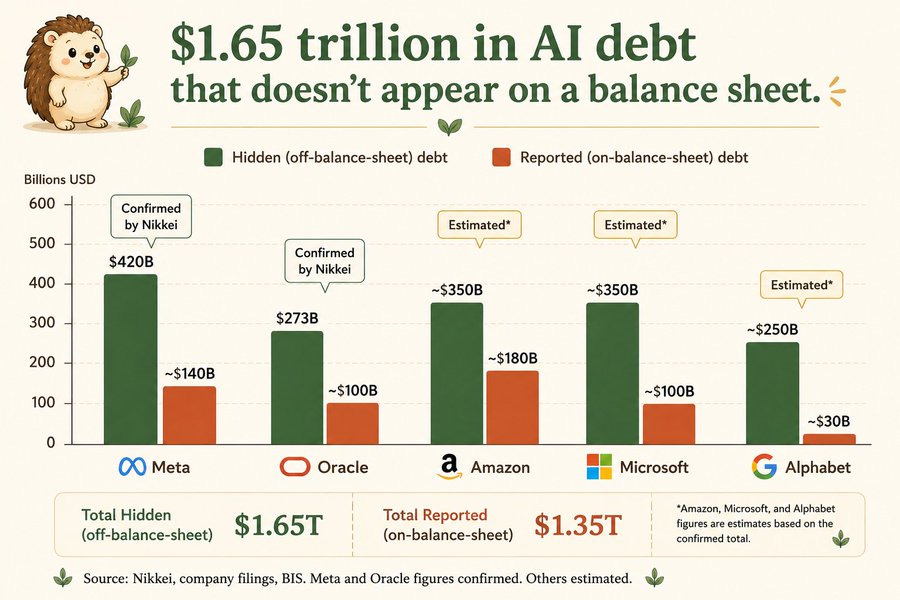
It’s astonishing that these companies owe more off their balance sheets than on them, and the accounting rules allow this until the data centers they’re building go live. Four of these five companies will report earnings in the next two weeks and it will be interesting to see whether markets will acknowledge these new revelations or pretend that everything is awesome. The reported debt will look manageable. The $1.65 trillion will be in the small print. Bloomberg TV and CNBC will probably put up a good cheerleading effort, but an Enron-y reckoning could be in the offing.
Thankfully, these five firms make up only around 26%-28% of the Nasdaq’s $41 trillion market cap, so even if they went bankrupt and their stock prices collapsed, everything would still be immutably and permanently awesome!
Losing the AI war to China
Big tech companies were inclined to go big in order to win the battle for global AI dominance. Their managers couldn’t afford to be economic girly-men by taking the prudent and conservative approach in this winner-take-all struggle. Unfortunately for them, it seems that the winner-take-all war is now being lost, and lost quite bigly:
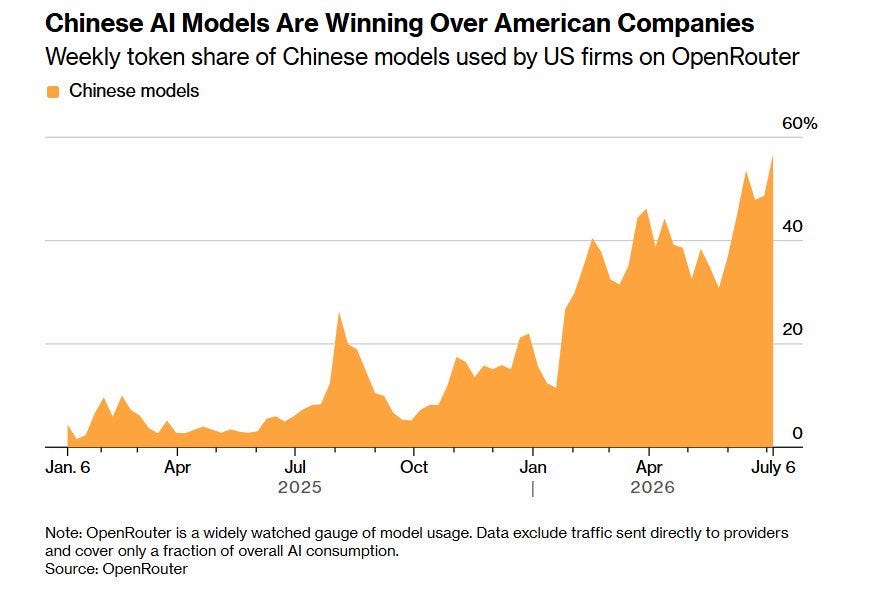
Part of the reason for this trend is that Chinese AI companies have closed the performance gap with those of their US rivals while offering their services at a fraction of the costs and many fewer restrictions. Last week, Beijing startup Moonshot AI, released their new model, Kimi K3. It beat Anthropic's Fable 5 and OpenAI's GPT-5.6 Sol on coding tests, and outperformed Opus 4.8 on broad rankings while costing 40% less. Then came a crushing blow to US-based AI offerings: on 27 July Moonshot will be giving Kimi away as an open-weight suite, so any company or government in the world can download it and run it on their own hardware - no restrictions and no subscriptions necessary.
This could well be a hydrogen bomb launched by China and striking all of those US-based $1.65 trillion data centers and it prompted the US to consider a Soviet-style response. Namely, according to Axios, the Trump administration is considering an executive order to ban Chinese open-source models within in the United States. US Commerce Department is considering adding Chinese AI labs to the Entity List.
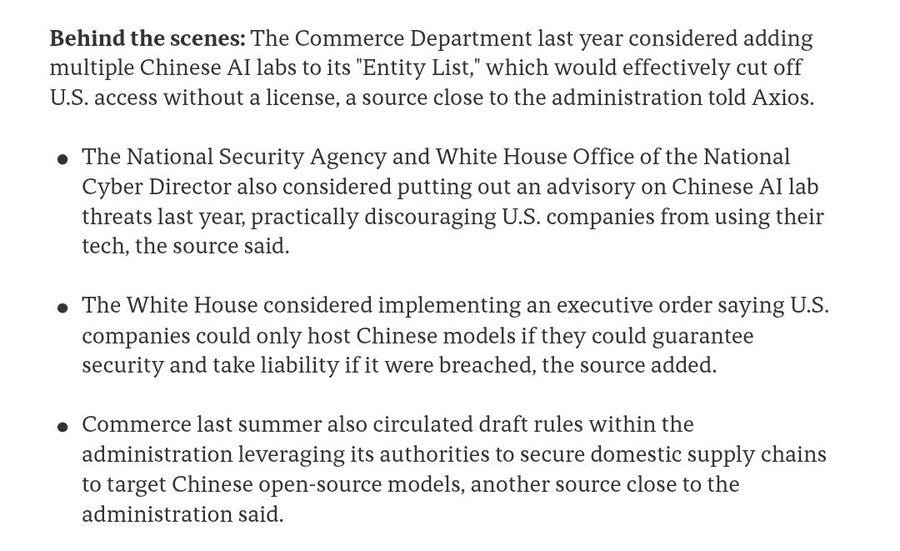
Curbing competition tends to have predictable results: the protected companies get to relax and, rather than producing winning innovations, they innovate at how best to skin their customers. But the reason why the government might respond in this counterproductive way could be exactly because of the colossal investment US companies already sunk into their fight for AI primacy.
The above doesn’t even begin to exhaust the list of headwinds facing the Trump administration and their friends and allies in the world. The war in the Middle East has escalated, Yemen’s Asarallah have closed the Bab-el-Mandeb Strait to Saudi shipping, oil price has added more than $20/barrel over the last three weeks, interest rates are rising across the board, inflation seems to be picking up again, and Argentina lost the World Cup to Spain.
To learn more about TrendCompass reports please check our main TrendCompass web page. We encourage you to also have a read through our TrendCompass User Manual page. For U.S. investors: an investable, fully managed portfolio based on I-System TrendFollowing is available from our partner advisory (more about it here).

Today’s trading signals
With yesterday’s closing prices we have the following changes for the Key Markets portfolio:
