

Inject nothing!
Key Markets report for Friday, 15 May 2026

This weekend will mark two weeks since the Hantavirus scare has first made the headlines. Unlike previous “Public Health Emergencies of International Concern,” like the Monkeypox, Marburg virus, disease X and the bird flu, Hantavirus story isn’t going away. On the contrary, it seems that the fearmongering is still gathering momentum. World Health Organization’s chief announced that he expected “more cases” of hantavirus would be announced soon.
Yesterday, the Telegraph ran a story that hantavirus can remain in human semen for up to six years and has the potential for sexual transmission even after a person has recovered, according to a “peer-reviewed study.” I can’t imagine where they are going with such “peer-reviewed studies,” but it’s safe to say that the media are treating this new scare much more seriously than the others since Covid.
“Safe and effectives” are in the pipeline already
As we saw in last Thursday’s report, the usual suspects have been extremely busy developing a vaccine to keep us all safe from transmission, hospitalization and death:
“In the summer of 2024, Moderna partnered with the Korea University Vaccine Innovation Center to develop an mRNA-based hantavirus vaccine, and they were not the only ones. Big pharma and the U.S. Department of Defence have been working on 13 different hantavirus vaccines.”
Of course, we all appreciate how incredibly safe and effective vaccines are, so we can rejoice at the great news. However, there are some who consider themselves experts and would disagree with that contention; I mentioned some of them in the past and I thought I should do so again, just in case.
Since the early days of the last extremely scary pandemic, I’ve participated in weekly 2-hour Zoom calls of a group called “Medical Doctors for Covid Ethics,” which gathered many of the world’s most eminent scientists including doctors, virologists, epidemiologists, molecular biologists, public health officials, pathologists, and data scientists. Individuals like Peter McCullough, Robert Malone, Jay Battacharia, Robert F. Kennedy Jr., Carrie Madej, Sucharit Bhakdi, Roger Hodkinson, Pierre Kory and many others with extensive discussions following these presentations.
An astonishing story
About two years ago, we had a remarkable presentation by the British data scientist Craig Paardekooper (the whole 2h session is available at link), who analyzed US VAERS database which contains extensive records of adverse reactions to vaccines. Among other things, he focused on the reports’ “recovery” status. Namely, for people who reported an adverse reaction, they can also report whether they have recovered or not by entering either a YES (I have recovered from the adverse reaction) or a NO (I have not recovered).
Paardekooper counted all these yeses and nos for every year from 1991 to 2022 for all ages between 0.08 and 85 years old. His full VAERS data analysis is here: https://howbad.info/recov5.pdf. The charts Paardekooper put together tell an astonishing story. The one below shows the recovery rates (YESes) for all ages for years 1994, 2011, 2021 and 2022:

What the chart conveys is that over the last 30 years, fewer and fewer people have recovered from adverse reactions to vaccines. Paardekooper then constructed a boxplot chart showing the recovery rates for all ages for each year from 1991 to 2022, which could be the most important chart in the world:

The trend could not be clearer: for over three decades, fewer and fewer people have been recovering from vaccine adverse effects. One would think that with time, vaccine manufacturers would be producing increasingly better, safer and more effective products. However, the data suggests the exact opposite: with time vaccines have been getting less and less safe, with a particularly sharp decline occurring in 2022, for some reason. It’s almost like something unusually unsafe was introduced in 2021?
Why should that be? There could be a few explanations. Evidently, vaccine manufacturers are immune at law and risk no liability lawsuits if they distribute flawed products. We also know that producing shoddy products is a lot cheaper than producing quality ones. Then there are more sinister explanations, but we need not venture there. My main purpose in sharing the above was to provide information I thought could be a relevant contribution to informed consent.
To learn more about TrendCompass reports please check our main TrendCompass web page. We encourage you to also have a read through our TrendCompass User Manual page. For U.S. investors: an investable, fully managed portfolio based on I-System TrendFollowing is available from our partner advisory (more about it here).

Today’s trading signals
With yesterday’s closing prices we have no new signals for the Key Markets portfolio. Your exposure should remain unchanged, as follows:
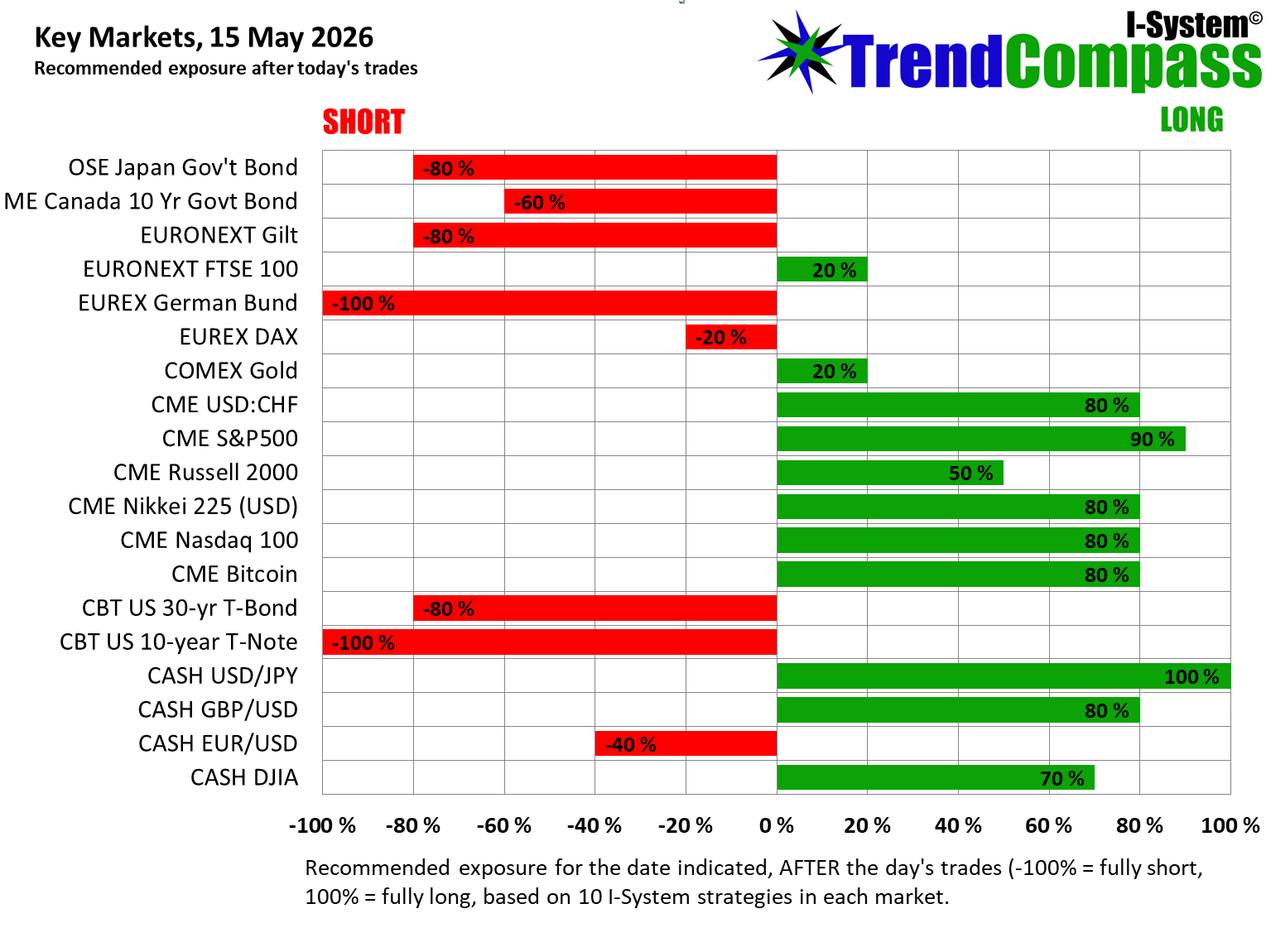
The full report is below:

Best regards,
Alex Krainer
Thank you.
Watching your updates on virus. Won’t be getting any more shots. 🙏