

May Christmas bring peace
Key Markets report for Wednesday, 24 December 2025

Through 2025, the world felt like it was on the verge of an outbreak of another World War on the European continent. Events that have been escalating the tensions had many disconcerting parallels with those leading to the outbreaks of World Wars I and II. We should hope that today, restraint and reason will prevail and avert another such tragedy.
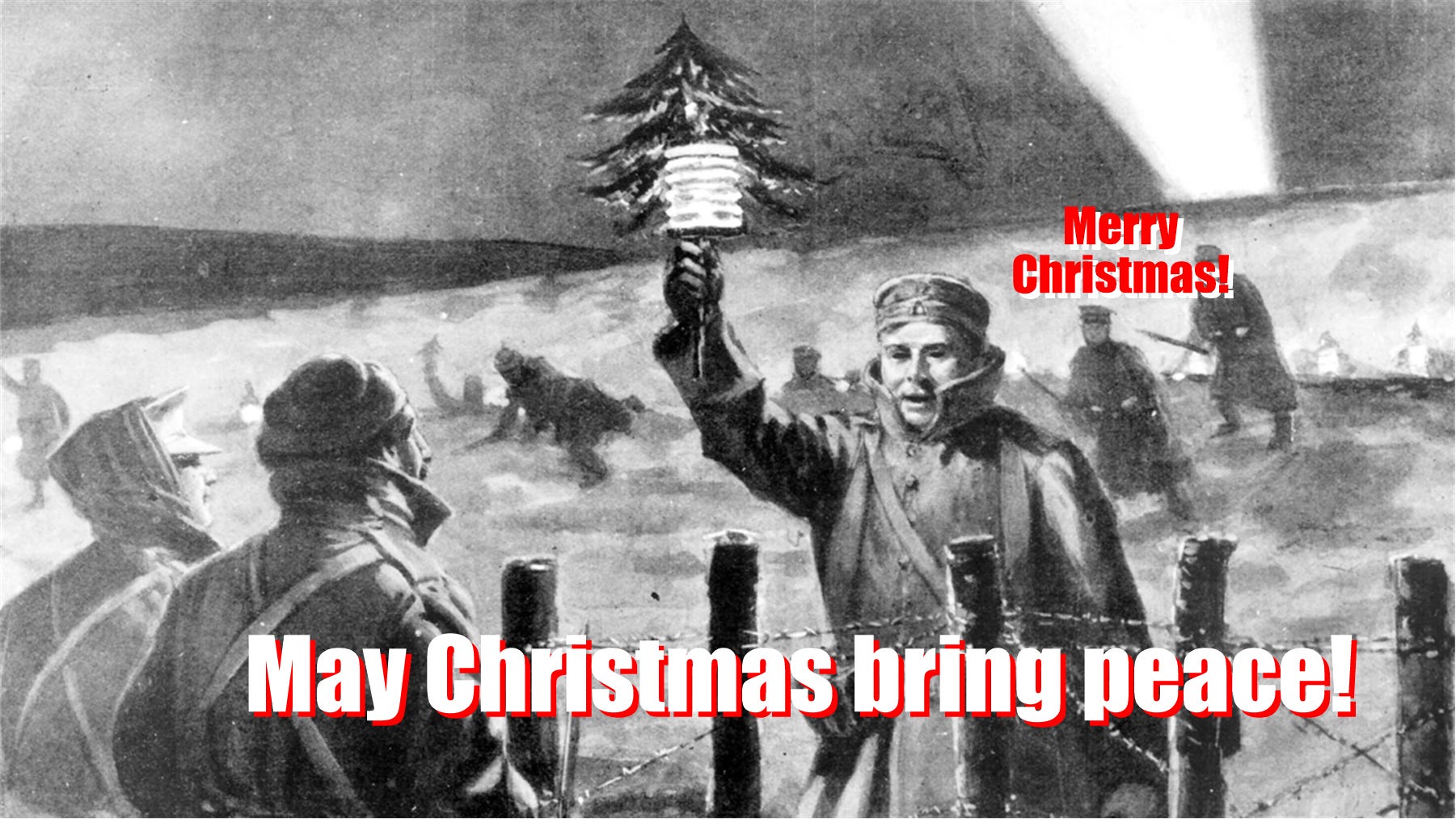
It takes a great deal of effort and malicious deception to induce ordinary people to leave their families behind and risk their lives in miserable muddy trenches in order to kill and risk being killed by other ordinary people who would also prefer to be at home with their families. Ordinary people do not harbor gratuitous hatred of “the other.” To the contrary, they easily understand that those others are, in fact, just like them. This reality manifested itself in the most extraordinary way through the Christmas truce of 1914.
The Christmas truce
World War I started in August of that year, between the Axis powers (Germany, Austria-Hungary, and Italy) and the triple alliance of Great Britain, France and Russia. Officers and soldiers on all sides expected that the war would be limited and that it would be over within six weeks. That was the result of war propaganda calculated to encourage young men to enlist and do their duty.
But nobody won a quick victory and by December 1914 it became clear to all that they were stuck in a stalemate, occupying hundreds of miles of trenches through France and Belgium. At some points along the front, combatants were dug in less than 100 feet from their “enemies.” As losses mounted and the stalemate hardened, the troops lost their enthusiasm for war, and a “live and let live” attitude began to take hold. Neither side fired at the other during meal times, and friendly comments were frequently bandied about across No Man’s Land.
In a letter published by the Edinburgh Scotsman, Andrew Todd of the Royal Engineers wrote that soldiers along his stretch of the Front, “only 60 yards apart at one place… [had become] very ‘pally’ with each other.” With Christmas approaching, the scattered gestures of goodwill across enemy lines increased. Instead of bullets, the troops would occasionally hurl newspapers (weighted with stones) and ration tins across the lines.
Chocolate cake and a concert
About a week before Christmas, German troops near Armentieres slipped a “splendid” chocolate cake across the lines to their British counterparts along with a surprising invitation:
“We propose having a concert tonight as it is our Captain’s birthday, and we cordially invite you to attend – provided you will give us your word of honor as guests that you agree to cease hostilities between 7:30 and 8:30…. When you see us light the candles and footlights at the edge of our trench at 7:30 sharp you can safely put your heads above your trenches, and we shall do the same, and begin the concert.”
The concert was held as agreed, with the German troops singing “like Christy Minstrels,” according to one eyewitness account. Each song earned enthusiastic applause from the British troops, prompting a German to invite the Tommies to “come mit us into the chorus.” One British soldier boldly shouted, “We’d rather die than sing German.” The jibe was returned with a good-natured reply from the Germans: “It would kill us if you did.” The concert ended with an earnest rendition of “Die Wacht am Rhein,” before the troops dispersed back to their miserable trenches.
Extraordinarily fine men
Elsewhere along the Front, arrangements were worked out to retrieve fallen soldiers and give them proper treatment or burial. In a letter to his mother, Lt. Geoffrey Heinekey described one such event on December 19:
“The Germans then beckoned to us and a lot of us went over and talked to them and they helped us to bury our dead. This lasted the whole morning and I talked to several of them and I must say they seemed extraordinarily fine men…. It seemed too ironical for words. There, the night before we had been having a terrific battle and the morning after, there we were smoking their cigarettes and they smoking ours.”
By Christmas Eve, the German side of the Front was glowing with small Christmas trees set up, sometimes under fire, by troops determined to commemorate the holy day. In his book, Silent Night: The Story of the World War I Christmas Truce, historian Stanley Weintraub wrote that,
“For most British soldiers, the German insistence on celebrating Christmas was a shock after the propaganda about Teutonic bestiality, while the Germans had long dismissed the British as well as the French as soulless and materialistic and incapable of appreciating the festival in the proper spirit… Regarded by the French and British as pagans – even savages – the pragmatic Germans were not expected to risk their lives on behalf of each beloved Tannenbaum. Yet when a few were felled by Scrooge-like gunfire, the Saxons opposite the [British line] stubbornly climbed the parapets to set the endangered trees up once more.”
The gospel of hate lost its allure
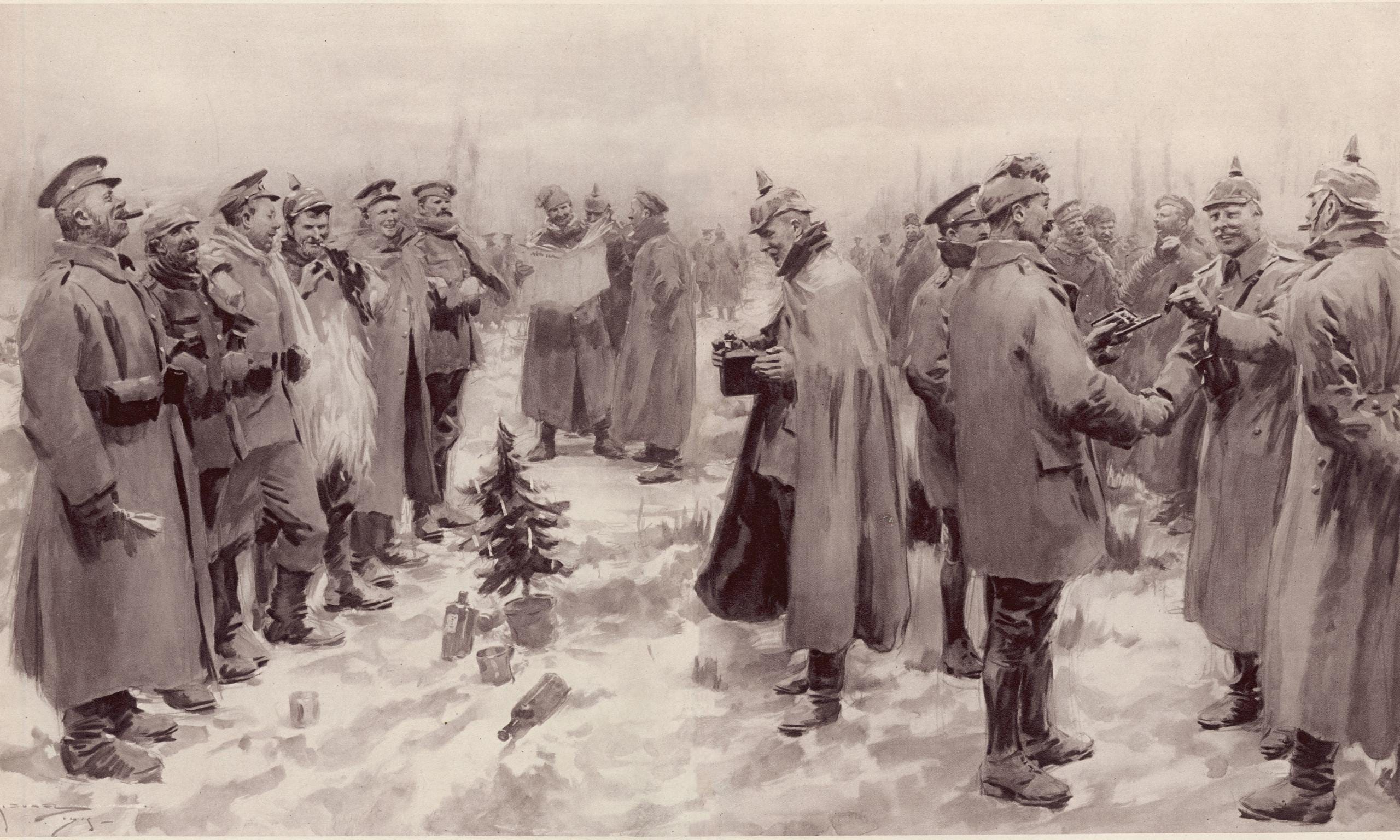
Along the Front, troops started to climb out of their dugouts, fearfully at first, then enthusiastically. Greetings, cigarettes, handshakes and gifts were exchanged. Carols were sung in German, English, and French. Near the Ypres salient, Germans and Scotsmen chased after wild hares that, once caught, served as an unexpected Christmas feast. In some places, soldiers organized football matches on No Man’s Land, as recorded in many letters and journals.
In a January 2, 1915 account of the Christmas Truce, the London Daily Mirror reflected that “the gospel of hate” had lost its allure to soldiers who had come to know each other. British author Arthur Conan Doyle, who lost his son to the war, wrote that, “It was an amazing spectacle,” which “must arouse bitter thought concerning the high-born conspirators against the peace of the world, who in their mad ambition had hounded such men on to take each other by the throat rather than by the hand.”
War conspirators demand maximum slaughter at minimum expense
In a remarkable letter published by The Times of London on January 4, a German soldier stated that “as the wonderful scenes in the trenches [during Christmas] show, there is no malice on our side, and none in many of those who have been marshaled against us.” The malice was all with the “high-born conspirators against the peace of the world,” who orchestrated the war. As British historian Niall Ferguson points out, their plans for the world required “Maximum slaughter at minimum expense.”
Scottish historian Roland Watson wrote, “The State bellows the orders ‘Kill! Maim! Conquer!’ but a deeper instinct within the individual does not readily put a bullet through another who has done no great offense, but who rather says with them, ‘What am I doing here?’”
This extraordinary 1914 episode showed, in perfect contrast, the difference between the ordinary people and those who send them to war. Today, exactly 111 years later, it is more important than ever to remember the Christmas Truce of 1914 and hope that this spirit should prevail for all eternity and that people will take each other by the hand and not by the throat.
Merry Christmas!
To all who celebrate, I wish you and your families a blessed Christmas.
To learn more about TrendCompass reports please check our main TrendCompass web page. We encourage you to also have a read through our TrendCompass User Manual page. For U.S. investors: an investable, fully managed portfolio based on I-System TrendFollowing is available from our partner advisory (more about it here).

Today’s trading signals
With yesterday’s closing prices we have the following changes for the Key Markets portfolio:
