

Mythbusting: trading commodities is risky!
Key Markets report for Thursday, 26 March 2026

The volatile and uncertain times we are in and those ahead of us for years to come will almost certainly cause commodity prices to rise considerably from their current levels. The commodity price inflation in this sense, will reflect the decline in the currency’s purchasing power. To avoid having the value of their savings decimated by inflation, investors should consider gaining exposure to commodity prices.
For most investors, this means seeking out commodity companies to invest in, but few venture to trade the actual commodities themselves because they believe that trading commodities is very risky. It’s one of those beliefs that seem to have become true by repetition. Trading commodities can be risky, in a same way as driving a car can be risky: the more aggressively you drive, the more likely you are to get hurt.
It’s risky only if you make it so
Today, nobody speculates on commodities by buying bags of coffee, bushels of corn or barrels of oil. Instead, we trade futures, ETFs or CFDs (contracts for differences) to gain exposure to commodity prices without ever touching the real stuff. An important advantage of trading commodity derivatives like futures or CFDs is that we do not need to pay the full price in cash to gain exposure to the market; instead, we only need to post the margin, which can be as low as 2% (or even less) of the value of the underlying asset. This is where the myth of riskiness of commodities comes from.
If the margin to trade some commodity is only 2% of its market value, this means that we can trade it with 50x leverage. Inexperienced and undisciplined traders will find much temptation in that and most of them (given enough time, all of them) will end up carried out of the markets on stretchers. Then they’ll tell their friends that “commodities are risky...” But in fact, it is the leverage that makes the risk, not commodities (speed makes the risk in driving, not the car).
For disciplined traders who do their risk management homework, this will not happen. CTAs (commodity trading advisors) who trade commodity futures every day in many cases have decades-long track records and their performance is often less risky than that of stock market indices.
We have two key measures of risk: one is the volatility of returns; the other is in terms of drawdowns. Volatility of returns is relatively more predictable (it should not vary widely over time) because it will correspond to the volatility of market price fluctuations. Drawdowns depend on the performance of our investment strategies and as such are not predictable, but the measure of past drawdowns is still a useful metric to observe. In terms of drawdowns, CTAs (Commodities Trading Advisors) have tended to do better than stock indices. The chart below shows drawdowns over time for the Societe Generale CTA Index and for the S&P 500:
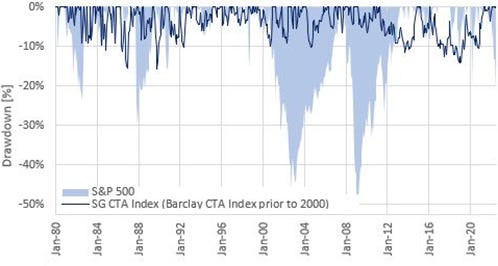
Clearly, individual CTAs might have significantly higher drawdowns, but this is also true of individual stocks, so in this sense index to index comparison remains valid. And in discussing individual funds, we should always keep in mind that risk is the flip side of performance. One of my favorite illustrations of this relationship is the performance of our friends over at Dunn Capital who trade commodity futures and who have been consistently transparent about their performance and about their drawdowns since before I have been in the hedge funds industry.
While they periodically share with me their performance chart, the most recent one I’ve seen was from 2024:
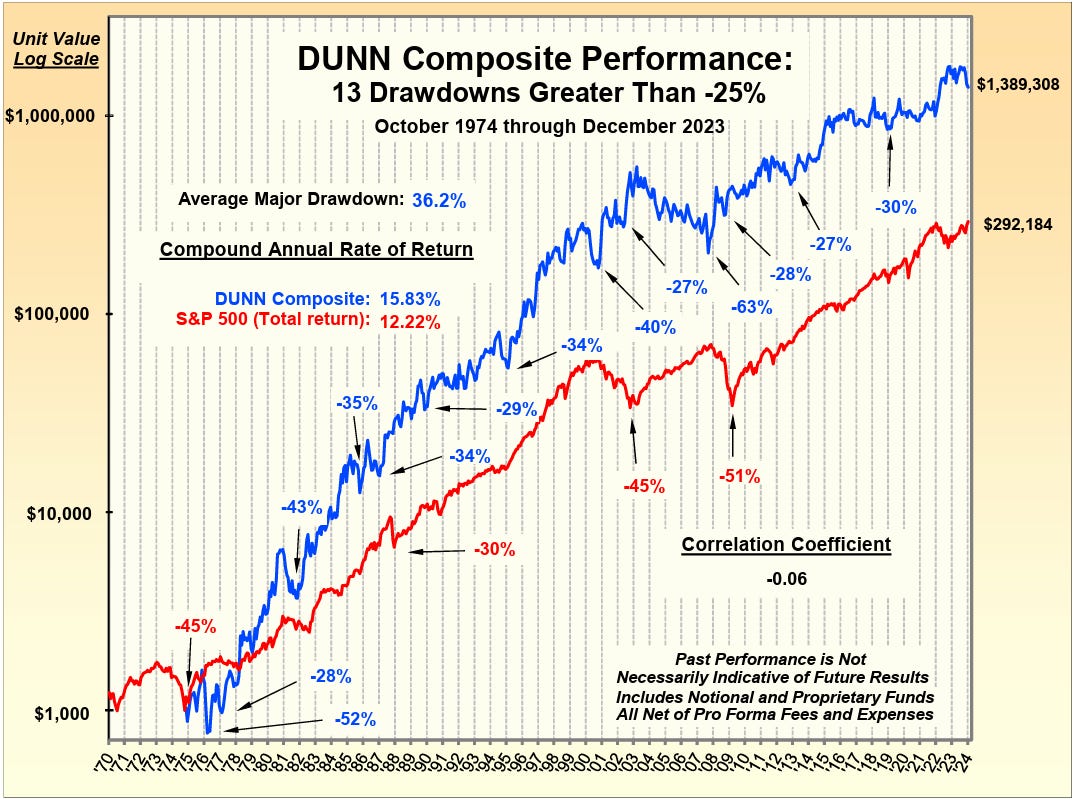
In spite of many significant drawdowns, Dunn Composite has generated more than 50 years of track record during which they’ve turned $1,000 into $1.39 million: a very significant outperformance over the S&P 500, which only turned $1,000 into about $209,000. Results of an investment process that’s spanned more than five decades can’t be accidental or lucky. It could be the most conclusive testament about trend following as an investment strategy.
Benefits should outweigh the risk
Probably the greatest benefit of gaining exposure to commodity price trends is the diversification it entails. As we’ve seen over the years, a diversified trend following portfolios tend to have a strong inverse correlation to traditional investment assets exactly when this matters the most: when stocks and bonds experience significant corrections or enter into bear markets.
In sum, not only are commodity investments not riskier than other asset classes, they can in fact reduce the overall risk in your investment portfolio without sacrificing performance. That should make commodities an important allocation alternative for every investor.
To learn more about TrendCompass reports please check our main TrendCompass web page. We encourage you to also have a read through our TrendCompass User Manual page. For U.S. investors: an investable, fully managed portfolio based on I-System TrendFollowing is available from our partner advisory (more about it here).

Today’s trading signals
With yesterday’s closing prices we have the following changes for the Key Markets portfolio:
