

On perceiving and mitigating risks
Key Markets report for Wednesday, 11 March 2026

In his recent piece, Inflationary Consequences of the War, Alasdair Macleod opened with the following paragraph:
“Like rabbits caught in the headlights of an oncoming car, investors barely moved in the face of last week’s events in Islamic lands. With the oil price moving sharply higher on Friday, there is bound to be a dawning realisation in the coming weeks that there’s an inflation shock coming. It is not yet seen to be serious, because there’s an assumption that the combined US—Israeli attack on Iran will be over in a week or two with Iran’s defeat and that normality will return.”
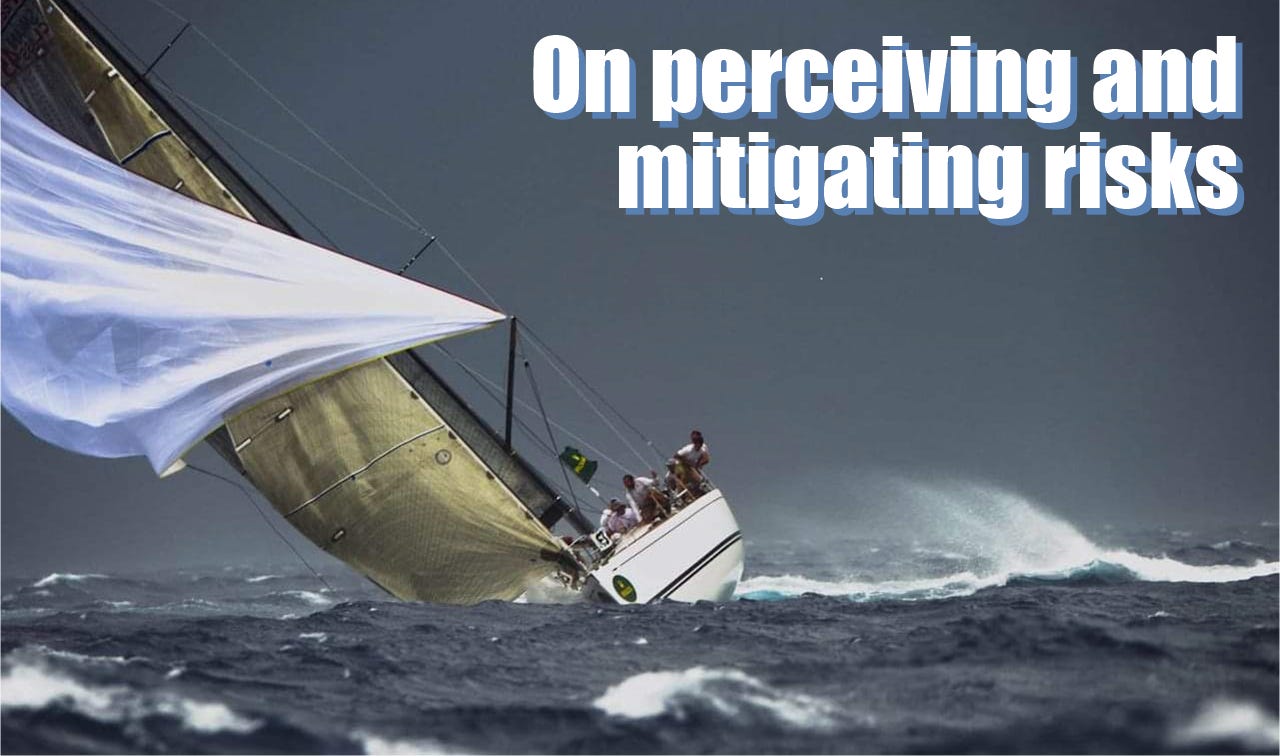
Macleod is making an important point: the way we perceive risk and react to it is one of the weak sides of our psyche. We are hardwired to live in a stable world and we expect that today should be like yesterday and tomorrow will be like today, more or less. This disposition often makes us complacent toward risks we should anticipate and mitigate.
Indeed, we tend to be unmoved by the risk of catastrophic events even when we rationally understand that they might happen, or even that they will happen eventually. Macleod’s formulation, “Like rabbits caught in the headlights of an oncoming car,” reminded me of a disturbing short video I saw online years ago (thus, not an AI generated clip). Here it is:
I found the video disturbing for a few reasons. We see a family enjoying their lunch at a ski resort when they notice an avalanche heading their way. And while the Mrs. and the kids are immediately concerned, Tomas, the father is content to watch the disaster roll their way, reassured in the belief that, “it’s controlled,” and that “they know what they’re doing.”
The normie posture
In the above video, Tomas displays what, to my mind is the typical mental posture of a “normie” who assumes that some class of experts has things under control and we need not question their competence or their benevolence. They have it under control and we can simply sit back and enjoy our lunch.
In reality, Tomas probably has no idea who these “they” are and he never met them, but his belief was strong enough to override what he almost certainly knew for sure: (1) an avalanche was heading in their general direction; (2) avalanches are dangerous; (3) they move downhill; (4) once they get going, they tend to gather momentum; (5) it’s better to be safe than sorry. Move your family out of harm’s way, just in case…
Does stupid correlate with cowardly?
Perhaps the most disturbing part of the video is Tomas’s transformation when he realizes that their lives are indeed in danger: he panics and leaves his wife and children behind to save his own skin. In effect, he segways seamlessly from stupid to cowardly. That raised the question in my mind: does cowardice correlate with stupidity? I don’t know the answer to that question, but it’s possible: being prepared to cope with risk should at the very least keep one from panicking.
It is important to recognize that Tomas wasn’t a uniquely stupid/cowardly man. Most of us have this “normie” circuitry and we tend to simply disbelieve the evidence that we are in mortal danger even when it’s staring us in the face.
Hardwired for complacency
In the past, I wrote about other examples of this phenomenon in this newsletter. Here’s an excerpt from a 2021 newsletter:
We tend to worry about risk events only if we experienced them in our recent past and if they had an emotional impact in our lives. If risk events are abstract or remote in our emotional experience, we are likely to disregard them even when we are rationally aware of them. This was shown in numerous studies of populations at risk from hurricane strikes along the Atlantic Coast and Gulf of Mexico in the USA and volcanic eruptions (Hawaii’s Kona Island, and Vesuvio and Etna in Italy).
These studies are highly instructive. For example, after more than 30 years of low volcanic activity, relaxed residents of Hawaii’s Kona island built entire neighborhoods exactly in the known lava flow areas. Because they experienced no lava activity in decades, Kona’s residents disregarded the risk. In May 2018 however, one of the volcanoes erupted sending rivers of lava through those neighborhoods, forcing the evacuation of 1,700 residents and destroying dozens of buildings – photographic evidence shows some of the results.
Complacency with regards to remote or abstract dangers makes us vulnerable to real future risk events. Irreversible scarcity of oil would certainly appear abstract since none of us have experienced it. For over a century now, we’ve enjoyed nearly uninterrupted access to cheap, abundant energy. We are barely aware of the extent to which this abundance has shaped the development of our economies and societies and how severely energy scarcity would disrupt them. The same could be said about high, or hyper-inflation...
Today, we could say that the avalanche has already started and many people, if they paid any attention at all, should be aware of the range of possible consequences that are certain to “snowball” our way over the coming months. And no, “they” don’t have it under control and they don’t know what they’re doing. Mitigating many of the risks coming our way should involve reducing our debts, gaining exposure to precious metals, energy and agricultural produce-related assets and being ready to hedge our downside risks if credit and equity markets turn south.
End times do not mean end of the world
On the opposite end of the spectrum from Tomas the normie, we find preppers who may be inclined to spend a fortune and a lifetime in preparations for cataclysmic events that may never come to pass. Such preparations can easily turn into an overkill since they can absorb much time and resources. We have to keep in mind that history is full of examples of once-in-a-century disruptions like world wars, hyperinflations and system collapses (Ottoman Empire, USSR, etc.)
Studying such crises should give us a much needed sense of perspective to gauge a good balance between being prepared but remaining engaged with the world in a productive way. What usually tends to happen is an accute crisis that may last 2-3 years. In that time, only a few months may be so severe that it threatens the very survival of a part of the population.
In such circumstances, having a reasonable stock of non-perishable foods, things like bicycles or efficient motorbikes, and tradable items like coffee, liquor and cigarettes should help, but far and away the most important precaution is a simple one: get to know your neighbors and be prepared to join hands if and when it becomes necessary.
To learn more about TrendCompass reports please check our main TrendCompass web page. We encourage you to also have a read through our TrendCompass User Manual page. For U.S. investors: an investable, fully managed portfolio based on I-System TrendFollowing is available from our partner advisory (more about it here).
Today’s trading signals
With yesterday’s closing prices we have the following changes for the Key Markets portfolio:
