

Summer of discontent
Key Markets report for Tuesday, 9 June 2026

In yesterday’s report I invoked the possibility that during the World Cup we could see a “false flag terror event like an attack on Israeli athletes…” Israel, however, is not among the 48 teams competing in the World Cup as they didn’t qualify, but nevertheless, an attack on Jewish or other visible targets is a conceivable event, foreshadowed in a recent statement by Senator Ted Cruz. Asked by an interviewer whether he was concerned about the sleeper cells, he replied as follows:
“There is a heightened danger of terrorism right now. … The danger of terrorism has never been higher than right now. … We know that radical Islamic terrorists entered this country and there’s a vulnerability all across this country.”
Senator Cruz may or may not know something, but we’ll see; the World Cup could end up being more eventful than normal. Meanwhile, it seems that the risk of pandemic-related lockdowns is still creeping. Last month the World Health Organization declared Ebola as yet another Public Health Emergency of International Concern (PHEIC) and in the UK at least, the authorities are preparing.
Last week (on June 3), UK Health Security Agency issued an urgent public health message (UPHM) to all National Health Service (NHS) hospitals, GP surgeries, clinics, and independent providers to heighten vigilance, immediately isolate suspected cases, restrict staff contacts and bar visitors to patients. This is consistent with the findings of Baroness Heather Hallett and her 1531-page inquiry into the Covid-19 pandemic, which concluded that when the next pandemic comes around, the authorities should protect us much harder and more proactively. It remains to be seen how far this particular PHEIC gets, but given multiple crises brewing around the world suggest that we are in for a summer of severe disruptions.
Meanwhile, the Middle East teeters..
In the Middle East, the situation is as tense as it’s been in the last 100 days and there’s no reason to expect a resolution any time soon. Although President Trump might like to extricate the United states from the conflict somehow, but the situation might be outside his control. From Iran’s point of view, this is the time to redraw the region’s security architecture, evict Western colonial powers from its neighborhood and deal a fatal blow to Israel.
Last night I sat down for a podcast on CapitalCosm podcast, about an hour before Donald Trump announced that Iran shot down an Apache helicopter, saying that the US must retaliate.
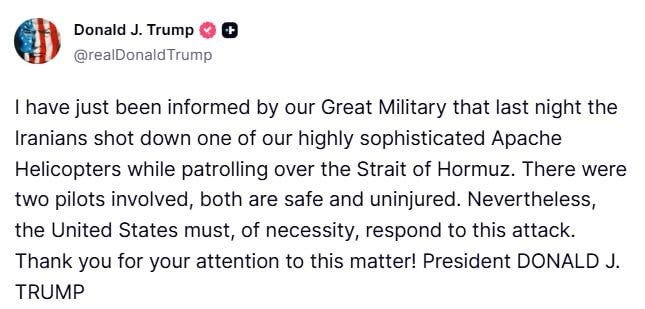
Up until that moment, it seemed that the situation had de-escalated and that a resolution of the crisis was close at hand. I tried to explain to my host why I believed that this impression was being deliberately contrived, along the lines of what I wrote here in Monday’s TrendCompass:
[The] developments could be so dramatically disruptive, we shouldn’t hope to learn the truth from either official sources or from their media stenographers. The prices of oil, natural gas, gold, silver, copper, fertilizers and other commodities could be severely impacted, as will interest rates and equity prices. For all these reasons, including Donald Trump and the Republican Party’s political future, the media will probably downplay the events and contrive best case scenarios for public consumption. However, I very much doubt that this story has a happy ending in the near future.
By this morning, the US and Iran have launched retaliatory strikes while, at the same time, Israel remains committed to pursuing their military assault on Lebanon, clearly on the wrong side of Iran’s red lines. Israeli government is unwilling to restrain their war drive and Iran has every incentive to see the current conflict through without delay. Over the coming weeks and months, Western and Israeli media will likely continue to push stories about negotiations and potential breakthroughs, but we should treat them with due skepticism.
Mind the seeds…
Along with all these pressure pots, social tensions in a number of European and South American countries are boiling over, promising a long summer of discontent and instability. Russian military seems poised for a large-scale offensive to wrap up the war in Ukraine and wars and terrorism continues to rage in multiple theaters across Africa.
In all, it seems like the global order is going to hell in a handbasket and the level of uncertainty is off the charts. In such moments we have to remind ourselves that this will not be the first painful transition for humanity. The world looked far more dismal in the aftermath of last century’s two World Wars, but the world didn’t end. It’s worth always keep in mind the Confucian saying that, when a large tree falls, it falls with great noise and destruction. At the same time seeds grow silently.
The post-World War II global order is that large tree, and what we are currently experiencing is the great noise and destruction of its falling. But while the fearsome destruction draws all the attention, the seeds are there too, silently growing.
To learn more about TrendCompass reports please check our main TrendCompass web page. We encourage you to also have a read through our TrendCompass User Manual page. For U.S. investors: an investable, fully managed portfolio based on I-System TrendFollowing is available from our partner advisory (more about it here).
Today’s trading signals
With yesterday’s closing prices we have the following changes for the Key Markets portfolio:
