

The invisible order
Key Markets report for Thursday, 28 May 2026

One of the great tourist attractions in Monaco is its Oceanographic museum, housed in a beautiful 19th century stone building, perched on the rock of its old city centre. It houses an extensive aquarium with great many species of marine life. In 1984, the aquarium accidentally released an aggressive tropical alga into the local marine habitat which ended up causing a great scandal.

The alga in question was Caulerpa taxifolia, commonly known as “killer algae” because it is an aggressive, fast-growing and highly invasive seaweed. Its escape (or accidental release) from the aquarium didn’t cause a concern at first, perhaps because it was assumed that it couldn’t survive the cold waters in the Mediterranean. But it adapted and it did survive.
In 1984, after its escape from the Monaco aquarium, only a small patch (about 1 square meter - about 10 square feet) was found offshore from the museum. By 1989, marine biologist Alexandre Meinesz documented it covering about 1 hectare; it had survived winters, showing an unexpected resilience in the Mediterranean. From around Monaco, it spread rapidly along the coasts of France, Italy, Spain, and beyond (eventually covering tens of thousands of acres / over 130 km² along ~190 km of coastline).
The strain proved surprisingly aggressive: it grew much larger and faster than the native tropical version. It forms dense, smothering mats (often called “monospecific meadows”) over rocks, sand, and mud, displacing native seagrasses, seaweeds, and other plants. An additional reason for concern was that taxifolia produces toxins (caulerpenyne) that deter most herbivores, reducing biodiversity: fish lose spawning/feeding grounds, other marine life (e.g., starfish, anemones) declines, and habitats shift dramatically. This is what earned it the nickname “killer algae” in the French press.
The environmental devastation
I moved to Monaco in 1996, and this case of “environmental devastation” was quite a story locally. For a few years, I could see the devastation myself - during the summers, I enjoy swimming for exercise and prefer to swim with a snorkel rather than with swimming goggles (watching the marine life below makes swimming much less tedious): the taxifolia really was everywhere!
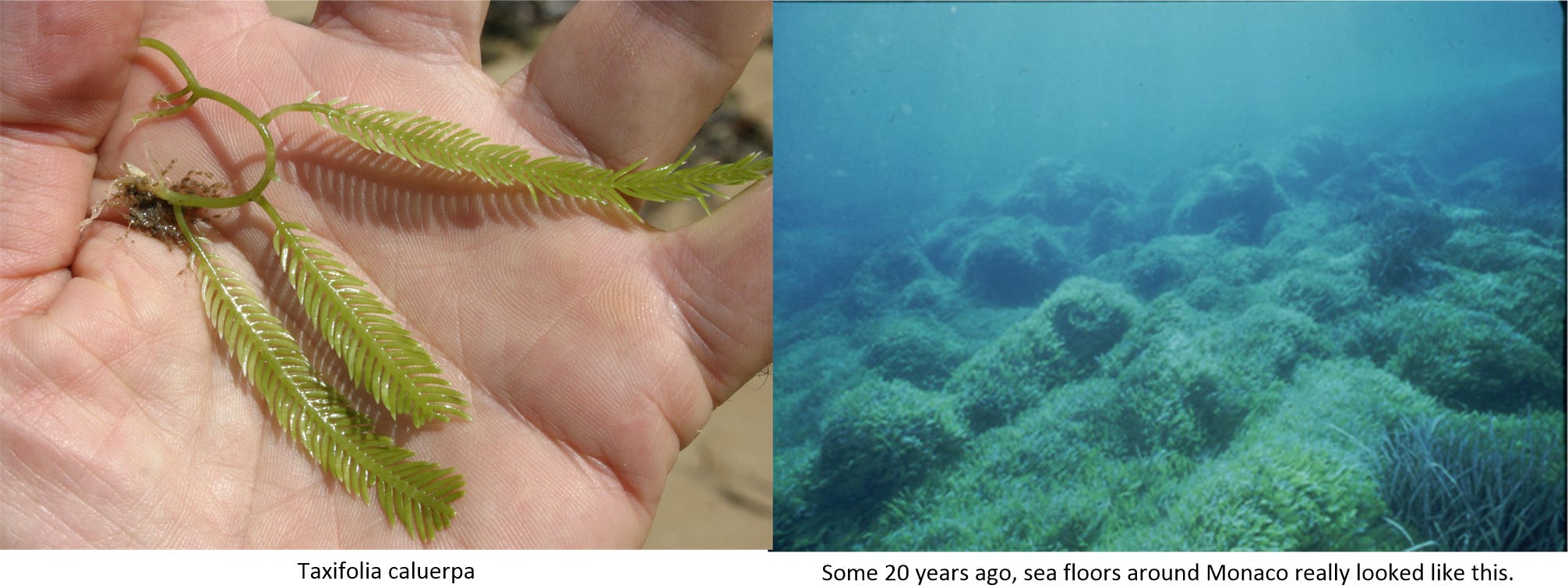
In the early 2000s, a colleague of mine who was a licensed diver participated in many organized actions with other divers to manually uproot Caulerpa taxifolia to try and reverse its spread, but this was quite obviously useless. At the time, I thought that natural balance would probably be restored somehow because, if any species became so widespread that it started making up the bulk of the biomass among the living organisms, some critter would eventually evolve the ability to feed on it and restore the area’s biodiversity.
If taxifolia survived in the local environment for some 20 years, I assumed it would stay there, but probably it would be beaten back and share the environment with other species. But this is not what happened: I still go out swimming in the sea whenever the weather permits it, and a few years ago, I noticed that the taxifolia was nowhere to be seen. In a few decades it went from invading everywhere to vanishing completely. When I realized it was gone, I started to pay attention, trying to spot it anywhere, but for a few years now I have not seen a single strand of taxifolia.
It is not clear what happened to it or why it vanished (I don’t know whether the same is true for Spanish and Italian coastlines). Marine biologists don’t have an explanation, which raises the possibility that there may be an invisible natural order in our environment, which can be violated, but only for a time. An aggressive, pathological intrusion can wreak significant damage to the local habitat, but in the end, the original natural order is restored. If that is the case, it may be that this invisible, natural order is robust and has deep roots and that any conquest by an alien pathology is fragile and can only sustain itself temporarily.
I’m aware of another, similar story from the natural world. Some 20 years ago we had an invasion of the Japanese plant called Kudzu (Pueraria montana) The species is native to eastern Asia, but it became very invasive in a number of regions in Croatia. Again, it caused some alarm in the local population, fears that it would destroy local habitats and their biodiversity. The local people tried to eradicate it manually and with pesticides, but this proved to be a Sisyphean task. But again, twenty years later Kudzu is nowhere to be found, perhaps again removed by some invisible natural order of things.
If such an order exists, it is neither measurable nor visible to us. Quantum physicist David Bohm famously tried to describe reality as having a deeper, undivided hidden order (the implicate order) where everything is interconnected: “In the implicate order, everything is enfolded into everything.” It should follow that we too, are part of that implicate order and that any and all structures and/or systems we build to try to force an alternative order into existence are doomed, and will be undone for reasons we cannot predict.
Food for thought
An example could be the story of the Bolshevik Revolution and the Chinese Cultural Revolution, perhaps the most radical and most ruthless attempts to create an alternative order in society. They held for two, three generations, then gave way to the original civilizational orders.
This should be relevant food for thought for the degenerates who are trying to ambush humanity into an unnatural order: inventing alternative genders, fantasizing about us being “hackable animals,” or thinking that food preferences are something you can overturn with a good PR campaign. Hopefully it won’t take three generations to overturn their dark Orwellian fantasies.
To learn more about TrendCompass reports please check our main TrendCompass web page. We encourage you to also have a read through our TrendCompass User Manual page. For U.S. investors: an investable, fully managed portfolio based on I-System TrendFollowing is available from our partner advisory (more about it here).

Today’s trading signals
With yesterday’s closing prices we have the following changes for the Key Markets portfolio:
