

Trump blinks!
Key Markets report for Monday, 23 March 2026

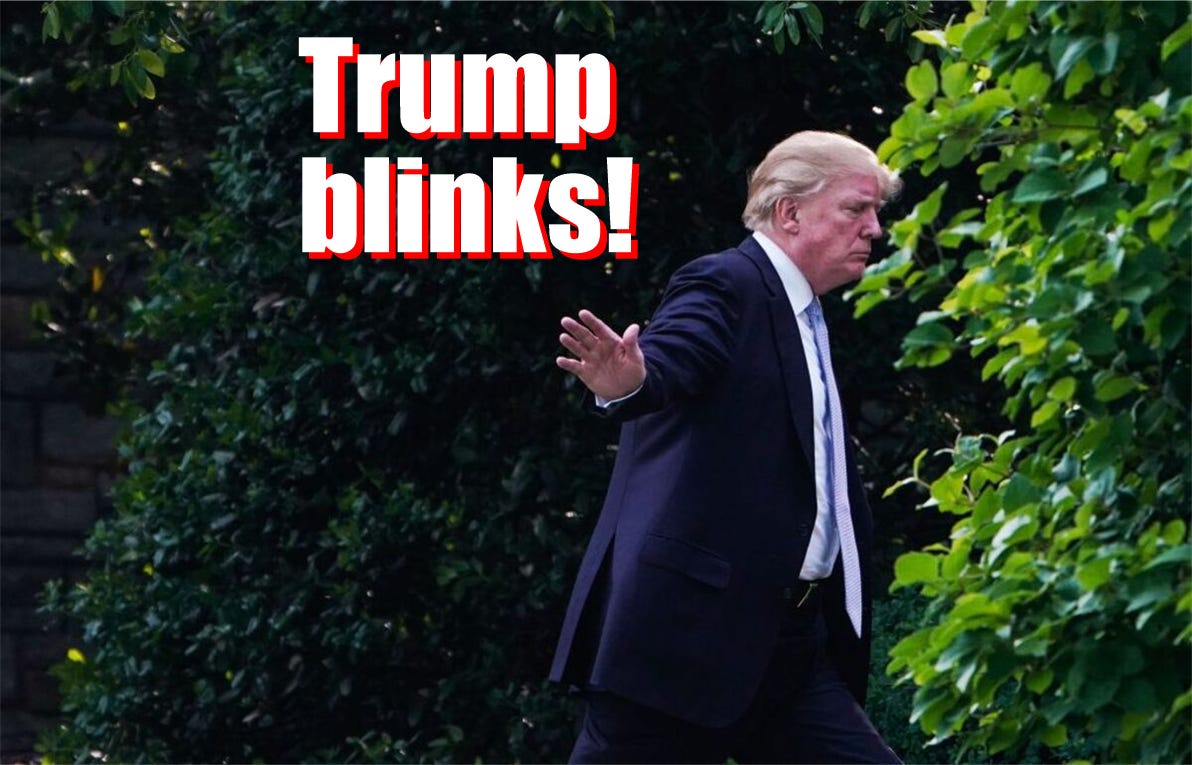
The war of words between Donald Trump and the Iranian government has seen sharp escalation and rapid shifts over the past four days amid an ongoing U.S.-Israeli military conflict with Iran, now in its fourth week. The verbal exchanges have centered on energy infrastructure, the Strait of Hormuz, threats of strikes, and mixed signals about de-escalation.
19 March: Trump distanced the U.S. from certain Israeli strikes on Iranian energy sites (e.g., the South Pars gas field) and warned Israel against repeating them. He also threatened to “massively blow up” Iran’s South Pars gas field if Iran attacked Qatar’s LNG facilities again, framing it as protection for U.S. allies while signaling reluctance for further escalation in energy targets.
20–21 March: Trump indicated the U.S. was “very close to meeting our objectives” and was considering “winding down” military efforts in the Middle East, emphasizing that other nations should police the Strait of Hormuz going forward. This suggested a potential de-escalation or shift in responsibility.
22 March (major escalation): In a dramatic reversal within about 24 hours, Trump issued a stark 48-hour ultimatum via Truth Social, threatening to “hit and obliterate” Iran’s power plants (starting with the largest) if Tehran did not fully reopen the Strait of Hormuz without threats.
Trump claimed the U.S. had already “blown Iran off the map,” described Iran’s military as devastated (air force and navy “dead”), and insisted objectives were nearly met—but warned of further action if the strait remained restricted. This all came along with soaring energy prices and the looming economic fallout from the war.
Iran responded defiantly, vowing to “completely” close the Strait of Hormuz indefinitely and strike regional energy/desalination infrastructure (including in Gulf states hosting U.S. bases) if the U.S. attacked its power plants. Iranian officials dismissed Trump’s threats as bluster and signaled readiness for massive retaliation.
Then today, Trump may finally have blinked: he announced “very good and productive conversations” with Iran over the prior two days toward a “complete and total resolution of hostilities.” He postponed any strikes on Iranian power plants and energy infrastructure for five days, pending ongoing talks. This led to market relief (e.g., oil prices dropping sharply and U.S. equity futures rising).
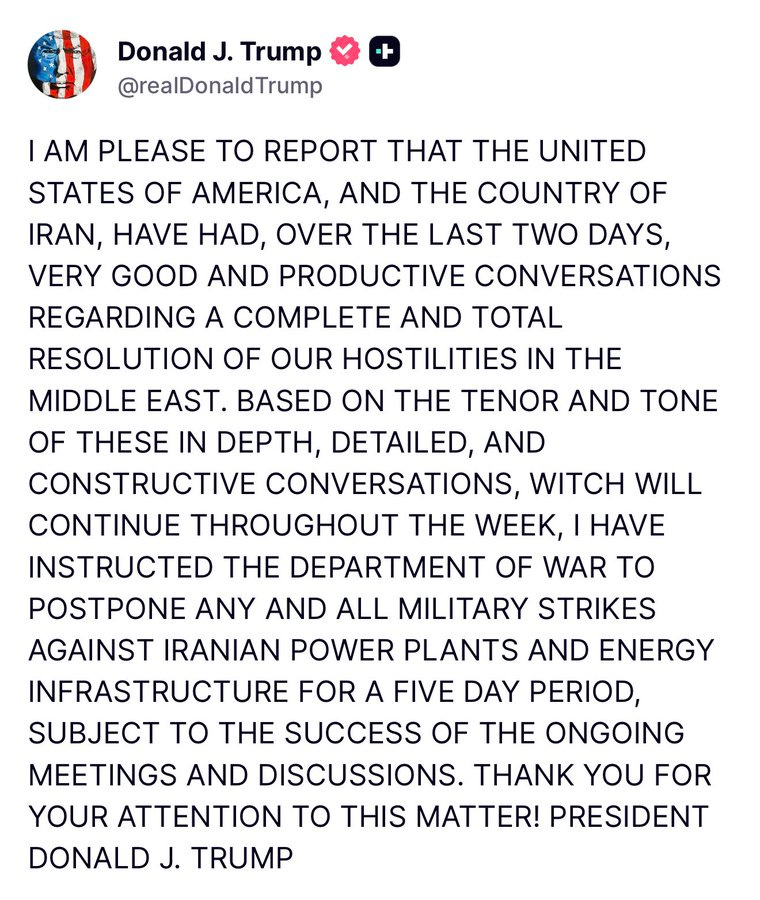
Trump negotiating with imaginary Iranians?
However, Iran’s Foreign Minister and other officials quickly denied any such talks, calling Trump’s claims a ploy to calm energy markets, lower prices, and buy time for potential military moves. An unnamed Iranian official, speaking to the Fars News stated that, “There is no direct contact with Trump, not even through intermediaries,” calling Trump’s erratic messaging as psychological warfare. One official thought that,
”Trump backed off after hearing that our targets would be all power plants in West Asia.”
Given the all-over-the-map messaging from Trump, alternating between victory claims, wind-down hints, harsh threats tied to the Strait of Hormuz, and sudden talk of negotiations, it’s Iran’s government which is winning, at least on the credibility front. Their messaging has been consistent, projecting defiance, readiness to escalate asymmetrically on energy targets, and rejection of U.S. narratives.
What spooked Trump?
Iranian officials’ claims that they still possess an arsenal of advanced weapons that have not yet been used received a corroboration from Russia’s former Defence Minister, General Sergei Shoigu:
Yes, what we are saying is true: Iran possesses an offensive missile system that the United States does not have. There are highly advanced missiles that have not yet been used. Iran has a stockpile of missiles capable of destroying the entire Middle East, not just Israel. We call on the United States and Israel to immediately stop the war and declare the failure of the military operation against Iran. Otherwise, the losses and damage will be a surprise. That is all.
If what General Shoigu stated is true, and if this was communicated credibly to Trump administration officials, this may have been the factor that caused Trump to blink and step off the war escalator.
Is peace within reach?
Spoiler alert: NO. Trump said that he would only pause strikes against Iranian energy and electricity infrastructure for a five-day period. This may crack the door open for negotiations and a settlement of the conflict, but the gap between the two sides’ terms appears to be light-years apart. Iran’s (alleged) terms to end the conflict include the following:
Legal guarantees there won't be another war.
No more US military bases in West Asia - within 30 days.
Reparations. As in $500 billion.
No more wars on the Axis of Resistance.
A new legal regime for the Strait of Hormuz.
The terms to settle the conflict set out by the U.S. side amount to a demand that Iran capitulate and include dismantling of Iran’s nuclear program, severe missile restrictions and an end of Iran’s support for their proxies in the Middle East. I believe that at this point, Iran has little incentive to accommodate Trump and return to the status quo which has kept their country suffocated under escalating sanctions for 47 years, and surrounded by US and British military bases and hostile proxy forces.
What should we expect from markets?
Today’s post by President Trump triggered a violent reaction in the markets: natural gas and oil futures collapsed (Brent crude oil is down -11% as of this morning), precious metals almost entirely reversed their overnight losses, while stock and bonds futures soared. I expect that this initial wave of euphoria (or profit taking) might dissipate and that energy prices will remain in a longer-term bull market and that in bonds and equity prices downside risk still looms large.
With respect to precious metals, I expect we’ll see a period of volatile consolidation that could offer buying opportunities during panicky corrections as we had on Friday and today during the Asian session. For anyone trading this turbulence, it will be essential to always keep plentiful “dry powder” (i.e. cash).
To learn more about TrendCompass reports please check our main TrendCompass web page. We encourage you to also have a read through our TrendCompass User Manual page. For U.S. investors: an investable, fully managed portfolio based on I-System TrendFollowing is available from our partner advisory (more about it here).

Today’s trading signals
With Friday’s closing prices we have the following changes for the Key Markets portfolio:
