

The AI money pit: risks and opportunities
Key Markets report for Monday, 25 May 2026

The advent of artificial intelligence (AI), like nothing since the dotcom boom, has generated a tech euphoria and narratives about the technology’s enormous potential as possibly the most important competitive differentiator for those economies that have the commanding lead in the field. At present, we are talking, basically, about the United States and China while powers like Russia, Iran and India are quietly brewing their own AI.

But as I reported here over the recent weeks, AI currently has flaws and issues that could prove very significant and even fatal to some of its presumed potential. As we’ve already seen, AI has significant issues with truth/reality; is subject to its creators’ political bias; has a remarkable tendency to confabulate, and is good at solving only certain, limited types of problem matter. The three articles published here last month are below:
Delusional spiraling: is AI going psychotic? (TrendCompass, 2 April)
New battlefront: AI vs. truth (TrendCompass, 9 April)
AI: “minimally sufficient” (for the most part) (TrendCompass, 30 April)
It is clear that the industry is very much aware of these flaws, and that some of them really could be very problematic. But it seems that the solution favored by industry leaders, is to throw more money at these problems and to overcome them by brute force: more chips, more servers, more computational power... As a result, they are building and planning to build thousands of new data centers and spending literally trillions of dollars on them. But where should all the trillions come from?
Where will the trillions come from?
Speaking at the BlackRock’s 2026 Infrastructure Summit (co-hosted with Global Infrastructure Partners/GIP and in partnership with Semafor) on 31 March this year in Washington, D.C., Larry Fink suggested that these trillions will have to come from people’s savings and pensions:
“… if we could get more and more Americans to think about growing with the United States we will have far [more?] then enough money to invest in this infrastructure. … If we are going to be the leader in AI, which we presently are, it’s just going to require trillions of dollars of investments. And if we don’t invest in it, China will be the global leader in this. …
This is a must. And if you think about how that translates, it translates into a more dynamic economy. We need the United States to grow over 2%. We need the U.S. economy to grow at 3%, especially with the deficits the Federal government has. And so, much of this money, not just private, is going to be coming from the private sector. From savings accounts, from pension accounts, from insurance companies and on and on.”
The anxiety over China’s potential to become the global AI leader seems to have induced a veritable frenzy to build up this brute force that should presumably help the U.S. win the AI race in spite of the fact that the U.S. already has 12 times more data centers than China has.
A massive strain on resources and life
According to the Brockovich AI Data Center Reporting, the U.S. has 33 operational data centers, 42 data centers under construction, an additional 25 pending approval, and 2,716 community reported potential data center locations nationwide.
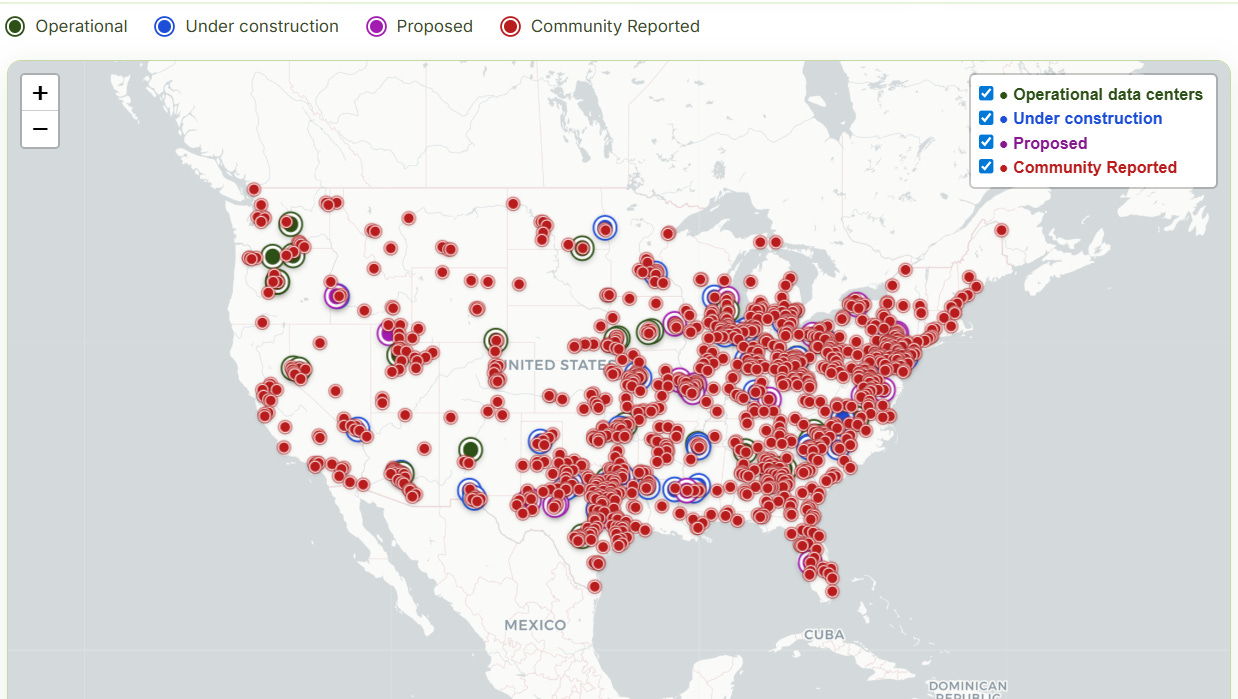
The problem is that this infrastructure is causing severe strains on the nation’s resources and causing a growing pushback from ordinary citizens. Data centers are imposing rapidly escalating costs for the surrounding communities in terms of high energy usage. They are also straining local water supplies due to their cooling requirements. Frequent hardware upgrades and replacement are generating significant volumes of electronic waste, and the constant humming from the generators, cooling systems and substations are reportedly impacting people’s daily life, disrupting sleep and causing issues like nausea, fatigue and mental problems.
In spite of all that, it doesn’t seem that the AI race will slow down any time soon, or take the people’s democratic will into account, as a recent case in point illustrates. Saline Township, a small town in Michigan tried to stop OpenAI & Oracle from building a $16 billion data center in their town. The people flooded their council meeting, put up signs all over town, and convinced their officials to reject the data center. The officials voted against the data center 4-1, and which presumably, should have been the end of it. But two days later the developers resorted to lawfare: they sued the township which then capitulated to the money power as they could not afford to fight back in court.
What’s it all for?
This case confirms once more that in our modern liberal democracies, lawfare beats the will of the people every time! One might ask then, what is the point of winning the AI race if it proves to be, at least in its current form, an exorbitant drain on the nation’s resources and a real impairment on the people’s quality of life? And what is it all for? To have better search engines or to train up mediocre virtual employees? Or is the AI race about something else entirely? In a recent interview with Tucker Carlson, economist Richard Werner (a highly recommended viewing), had a few choice thoughts:
“We are so close to the scariest, most dystopian system. This is what the drive to build all these thousands of data centers is about, to micromanage the world's population through the New Financial World Order. AI is really about that.
We're heading towards digital control systems where we have no more control over our liquid assets. It will be programmable, permission-based, so only what the central planners allow you to use your money for, at what time and place and location will be permitted.
And if you're in the wrong place, it's not going to work. And If you're buying the wrong book, it's not gonna work. Your money won't work outside a certain zone, whether it's 15-minute prison zone or whatever it may be. It is the totalitarian dictator's dream come true”
Professor Richard Werner, one of a small handful of economists worth reading and listening to, is not known as a loony conspiracy theorist and his interpretation should be taken seriously. But given the ruling establishment’s dogged determination to win the AI race, we are likely to see the impact of their multitrillion dollar investments in the markets too. They should significantly boost demand for energy and metals.
Commodity markets impact
Data centers could boost U.S. electricity demand by 10–14% over the next 4 years, requiring massive new grid buildouts which, in turn, will boost demand for metals. Copper will be the primary metal needed for the AI arms race, followed by aluminum, steel, silver, nickel, lithium, and cobalt. Copper’s superior electrical and thermal conductivity makes it “non-negotiable” for high-density setups including power cables, busbars, transformers, connectors, heat sinks/exchangers, liquid-cooling systems, and obviously, the grid infrastructure to deliver electricity.
Conventional data centers use between 5,000 and 15,000 tons of copper, but AI facilities (which is what Fink was talking about) can require up to 50,000 tons each (the scale corresponds to about 30 tons per MW of capacity. Current projections suggest that data centers could boost annual demand for copper averaging at about 400,000 tons over the next decade, causing potential global supply shortfalls of 25–30% or even more by 2035. By then, the cumulative demand tied to data centers and the requisite power infrastructure could exceed 4 million tons.
The next “beneficiary” of the AI arms race will be aluminum, needed in wiring and cabling, especially for higher-voltage transmission, and for certain components used in data center cooling systems. Combined data center annual demand for copper and aluminum could exceed 1 million tons by 2030.
In addition, large amounts of steel will be required for the buildings infrastructure, structural supports, and for server racks. The semiconductors, circuit boards and high-end electronics will boost demand for silver and gold and backup battery storage and UPS systems will require large quantities of nickel, lithium, cobalt and manganese.
How that translates
“And if you think about how that translates,” to use Larry Fink’s phrase, it will probably translate into a multi-year commodity price tailwind. This tailwind is already blowing: copper prices are trading very close to their historical all-time highs, but they might go still higher only, nobody could predict copper’s trajectory or how much higher the price could go:
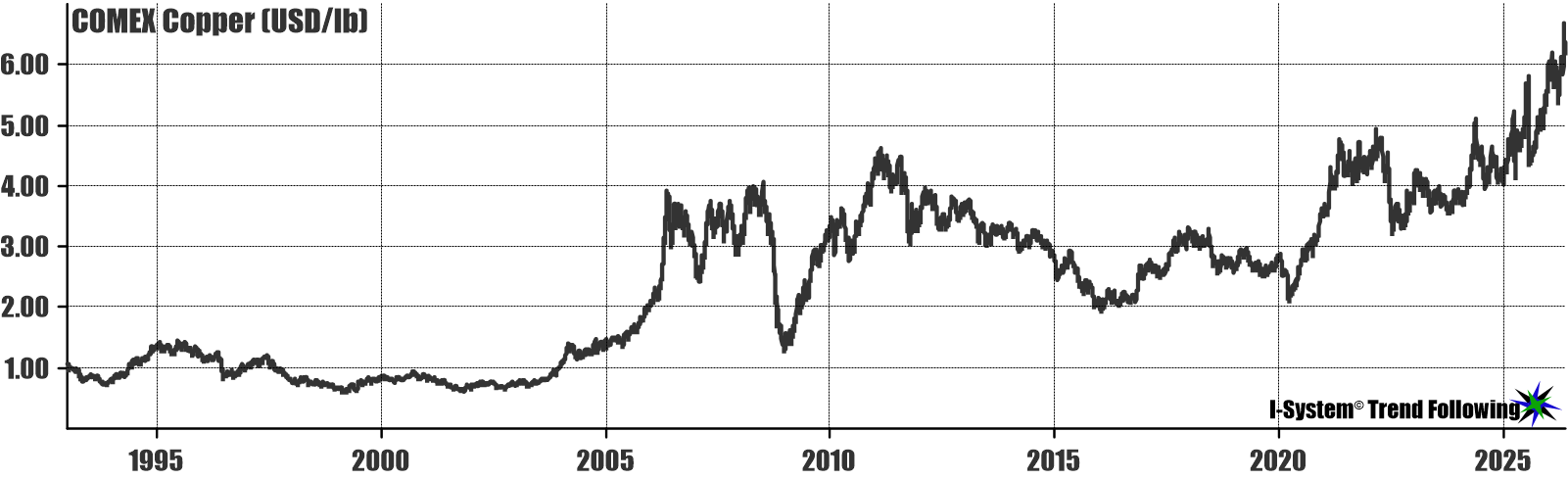
What’s quite apparent from the above chart is that the volatility of market fluctuations has increased sharply, particularly compared to what it was 20 years ago. In the future, we’ll have to get used to this - it is our new normal and it will be with us for years to come. Investors can catch the wave by trading commodity futures like COMEX copper, but alternatives include ETFs like CEPR (U.S. Copper Index Fund), COPX (Global X Copper Miners ETF), COPP (Sprott Copper Miners ETF), ICOP (iShares Copper and Metals Mining ETF) or SETM (Sprott Critical Materials ETF).
Of course, for timing and directional exposure to copper, silver, gold and energy commodities, and also to some of the above listed ETFs, we always recommend using systematic trend following strategies like the ones implemented by I-System TrendFollowing.
To learn more about TrendCompass reports please check our main TrendCompass web page. We encourage you to also have a read through our TrendCompass User Manual page. For U.S. investors: an investable, fully managed portfolio based on I-System TrendFollowing is available from our partner advisory (more about it here).

Today’s trading signals
With Friday’s closing prices we have the following changes for the Key Markets portfolio:
